MLN2238 (Ixazomib) 20S proteasome inhibition with lenalidomide deepens post-transplant myeloma response
Copy code to add this image to your page
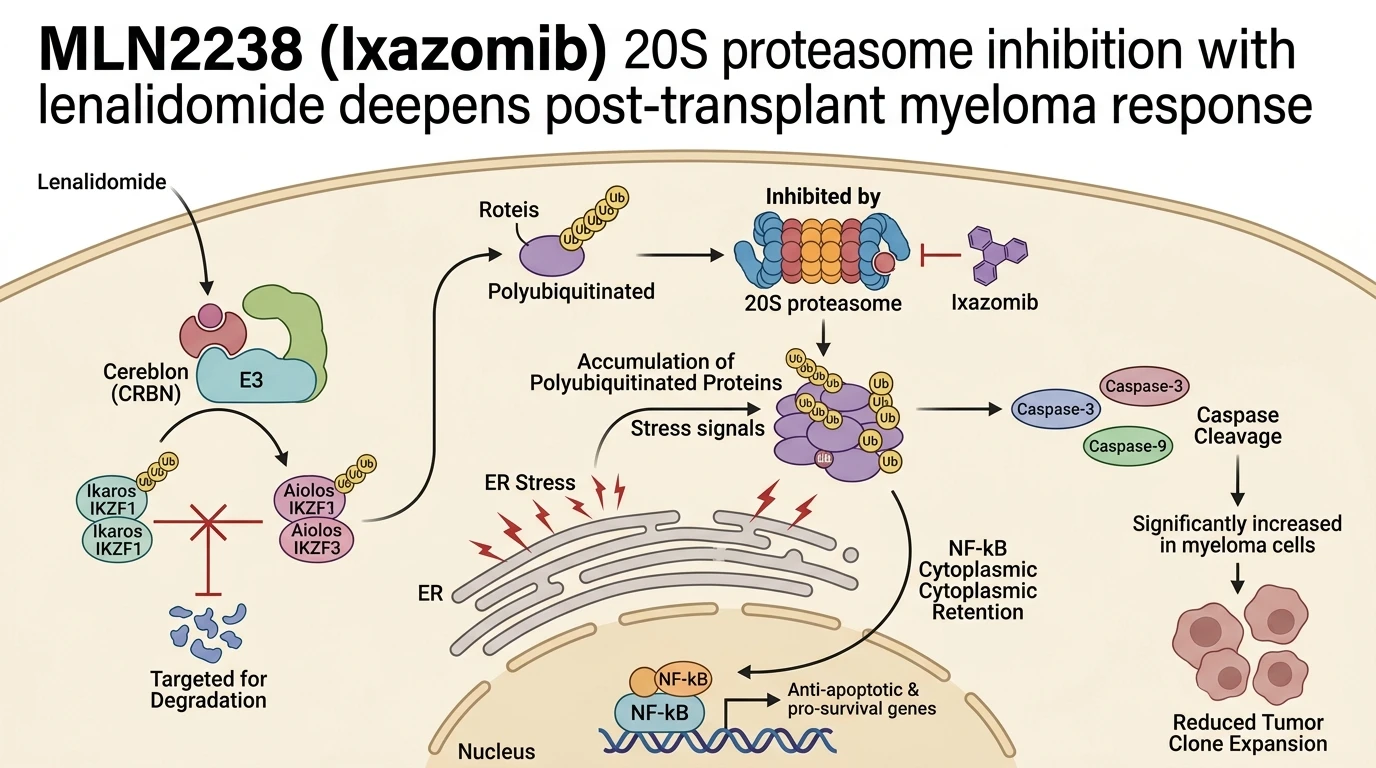
Targeting protein homeostasis represents a validated therapeutic vulnerability in plasma cell dyscrasias. Ixazomib citrate is an oral prodrug that rapidly hydrolyzes under physiological aqueous conditions to form its active metabolite, MLN2238 (Ixazomib). At the sub-nanomolar level, MLN2238 (Ixazomib) binds preferentially and reversibly to the beta 5 catalytic subunit of the 20S proteasome complex. This binding selectively blocks chymotrypsin-like proteolytic cleavage. At elevated concentrations, the agent also inhibits the trypsin-like (beta 1) and caspase-like (beta 2) catalytic sites of the proteasome core.
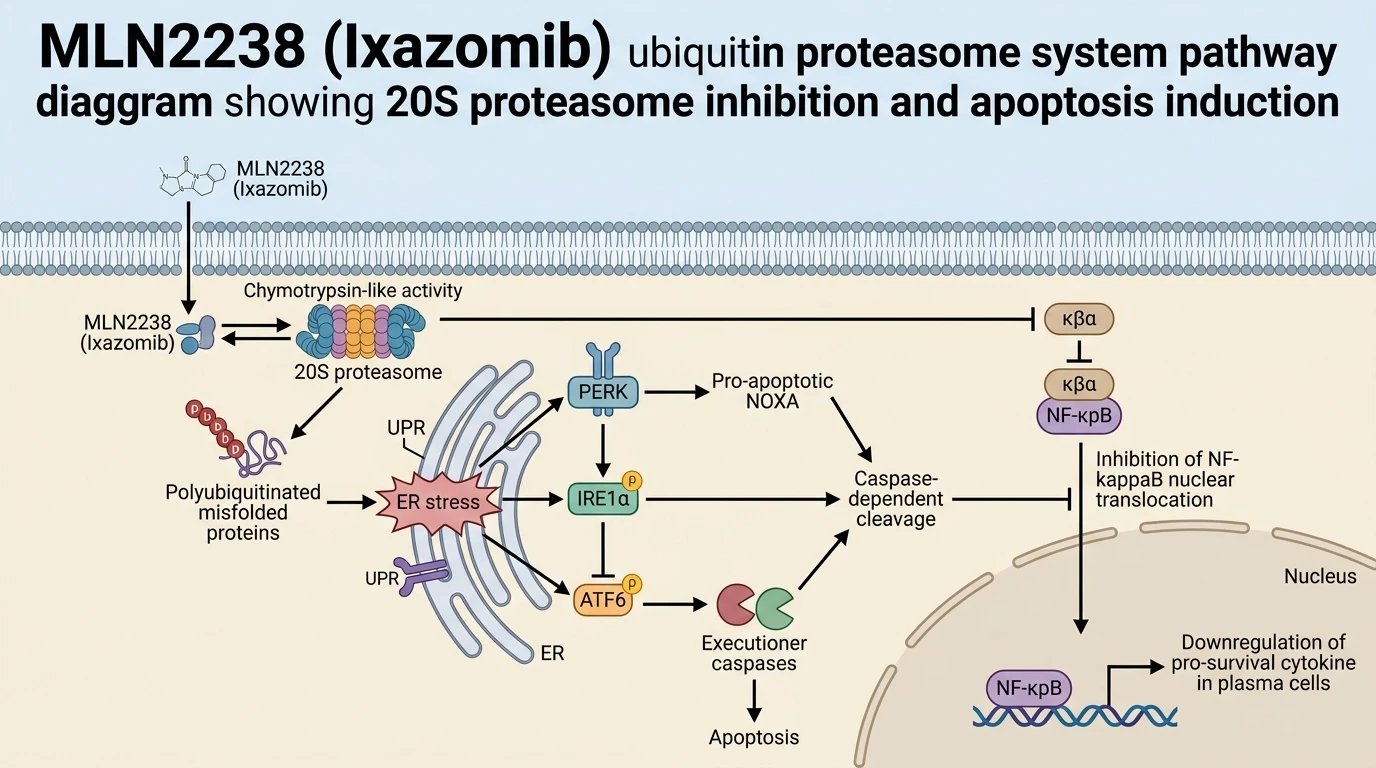
The proteasomal inhibition mediated by MLN2238 (Ixazomib) disrupts regulated protein degradation pathways within neoplastic plasma cells. Plasma cells possess high baseline protein synthesis rates, making them selectively vulnerable to catalytic proteasome inhibition. Disruption of proteasomal clearance triggers intracellular accumulation of polyubiquitinated misfolded proteins. This molecular congestion induces severe endoplasmic reticulum stress and activates the unfolded protein response (UPR). Sustained activation of UPR pathways—mediated via PKR-like ER kinase (PERK), inositol-requiring enzyme 1 alpha (IRE1 alpha), and activating transcription factor 6 (ATF6)—drives cellular apoptotic pathways through terminal upregulation of pro-apoptotic BH3-only proteins such as NOXA and subsequent activation of caspase-9 and caspase-3.
In addition to UPR-induced apoptosis, 20S proteasome inhibition disrupts key survival signaling networks. Proteasomal degradation of the nuclear factor kappa B (NF-kappaB) inhibitor, IkappaB alpha, is blocked. Consequently, NF-kappaB remains sequestered in the cytoplasm, halting its nuclear translocation and blocking transcription of pro-survival cytokines, adhesion molecules, and angiogenic factors within the bone marrow microenvironment.
Combining proteasome inhibition with immunomodulatory drug (IMiD) therapy generates mechanistic complementarity. Lenalidomide binds the E3 ubiquitin ligase component Cereblon (CRBN), recruiting transcription factors IKZF1 (Ikaros) and IKZF3 (Aiolos) for selective degradation. Concurrent administration of MLN2238 (Ixazomib) and lenalidomide simultaneously disrupts protein degradation pathways and transcriptional regulation, suppressing IRF4 and MYC expression while stimulating effector T-cell and natural killer cell immune responses.
Clinical evaluation of this all-oral combination maintenance strategy was conducted in a Phase II trial involving 64 patients with newly diagnosed multiple myeloma post-autologous stem cell transplantation (ASCT). Dual administration of MLN2238 (Ixazomib) and lenalidomide yielded significant response deepening over extended maintenance schedules. The complete response (CR) or stringent complete response (sCR) rate reached 43.0%, while the rate of very good partial response (VGPR) or better reached 89.1% across the post-transplant cohort.
Long-term outcome metrics demonstrated extended disease control under dual maintenance. The median progression-free survival (PFS) was 73.3 months. Longitudinal survival analysis established a 5-year PFS rate of 61.4% and a 5-year overall survival (OS) rate of 88.4%. Cytogenetic risk profiling revealed outcome stratification within the cohort. Patients categorized with standard-risk cytogenetics exhibited significantly longer PFS and duration of response relative to those with high-risk abnormalities, such as deletion 17p, t(4;14), or t(14;16).
Safety profiles remained clinically manageable during long-term exposure. Grade 3 or higher adverse events were predominantly hematologic and proved manageable with dose adjustments. Notably, the incidence of peripheral neuropathy remained lower than historically reported with parenteral proteasome inhibitors, supporting the feasibility of long-term all-oral combination maintenance after stem cell transplantation.
Clinical Efficacy and Pharmacodynamic Evaluation of Proteasome Inhibition Maintenance
Copy code to add this image to your page
MLN2238 (Ixazomib) targets the 20S proteasome core, selectively inhibiting chymotrypsin-like catalytic activity. Blockade of protein degradation pathways induces terminal endoplasmic reticulum stress and suppresses NF-kappaB survival signals in neoplastic plasma cells. When combined with lenalidomide immunomodulation following autologous stem cell transplantation, dual pathway targeted therapy prevents clonal resurgence and deepens clinical response rates in multiple myeloma.
All-Oral Maintenance Strategy Prolongs Progression-Free Survival Duration
The Phase II maintenance trial evaluated an all-oral regimen following autologous stem cell transplantation. Patients received combination therapy consisting of MLN2238 (Ixazomib) alongside lenalidomide. Long-term disease control exceeded historical monotherapy benchmarks. The observed median progression-free survival reached 73.3 months. Furthermore, the 5-year progression-free survival rate remained elevated at 61.4%. Overall survival at five years reached 88.4% across the evaluated cohort. Mechanistically, continuous proteasomal and immunomodulatory blockade prevents residual clone expansion. Steady target saturation maintains low tumor burden over extended treatment windows.
Response Depth and Cytogenetic Risk Stratification Dynamics
Sustained proteasome inhibition drove progressive response deepening in evaluable patients. Clinical evaluation confirmed a complete response or stringent complete response rate of 43%. The rate of very good partial response or better reached 89.1%. Cytogenetic profiles stratified survival outcomes significantly. Standard-risk patients achieved markedly longer duration of response compared to high-risk cohorts harboring structural chromosomal abnormalities. High-risk genomic lesions required alternative therapeutic modulation to sustain equivalent remission intervals. In this patient cohort, MLN2238 (Ixazomib) maintained tolerability without treatment-limiting cumulative toxicities.