PDGFR Inhibitors
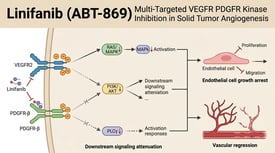
Platelet-derived growth factor receptors (PDGFRs) are a family of receptor tyrosine kinases (RTKs) that play critical roles in cell proliferation, migration, survival, and angiogenesis. The PDGFR family consists of two main types, PDGFRα and PDGFRβ, which can form homodimers or heterodimers upon binding to their respective ligands, PDGF-A, -B, -C, and -D. Ligand binding induces receptor dimerization and autophosphorylation of specific tyrosine residues within the intracellular domain, creating docking sites for various signaling molecules. This initiates a cascade of downstream signaling pathways, including the RAS/MAPK pathway, the PI3K/AKT/mTOR pathway, and the PLCγ pathway. These pathways collectively regulate gene expression, cell cycle progression, cytoskeletal reorganization, and cell survival, making PDGFR signaling crucial for normal development and tissue repair, but also a driver of various pathologies when dysregulated. Dysregulation of PDGFR signaling is implicated in a wide array of diseases, most notably various cancers and fibrotic disorders. In oncology, activating mutations or overexpression of PDGFRs, or overexpression of their ligands, contribute to the pathogenesis of several tumor types. Examples include gastrointestinal stromal tumors (GISTs), dermatofibrosarcoma protuberans (DFSP), glioblastoma, certain sarcomas, and chronic myelomonocytic leukemia.
Beyond cancer, PDGFR signaling is a key mediator of fibrosis in organs such as the lung, kidney, and liver, and is involved in conditions like atherosclerosis and rheumatoid arthritis due to its role in fibroblast activation and extracellular matrix deposition. The research progress and status of PDGFR inhibitors are well-advanced, with several approved drugs and a robust pipeline of compounds in clinical development. Imatinib, a pioneering multi-kinase inhibitor, was one of the first drugs to demonstrate remarkable efficacy in GISTs by inhibiting KIT and PDGFRα. Other approved multi-targeted RTK inhibitors with significant PDGFR inhibitory activity include sunitinib, sorafenib, regorafenib, and pazopanib, which are used in various cancers like renal cell carcinoma, hepatocellular carcinoma, and soft tissue sarcomas. These drugs often target VEGFR, KIT, and FLT3 in addition to PDGFR. Preclinical research continues to explore more selective PDGFR inhibitors and novel combination strategies to enhance efficacy and overcome resistance, particularly in glioblastoma and fibrotic diseases. Many compounds are in Phase I, II, and III clinical trials for a broader range of indications. PDGFR inhibitors can be broadly classified based on their selectivity (e.g., highly selective PDGFR inhibitors vs.
multi-targeted RTK inhibitors) and their binding mode (Type I inhibitors bind to the active conformation of the kinase, while Type II inhibitors bind to the inactive conformation). Early inhibitors were often multi-targeted, leading to a broader spectrum of activity but also more off-target toxicities. The development of more selective agents aims to mitigate these side effects. Chemically, they are predominantly small molecule tyrosine kinase inhibitors (TKIs). Other relevant general knowledge includes the challenge of resistance development, which can arise from secondary mutations in the receptor or activation of bypass signaling pathways. Off-target toxicities, such as hypertension, hand-foot syndrome, and fatigue, are common with multi-targeted TKIs. The importance of patient selection through molecular diagnostics, particularly for identifying specific PDGFR mutations or amplifications, is crucial for maximizing therapeutic benefit. Combination therapy strategies, often involving PDGFR inhibitors with chemotherapy, immunotherapy, or other targeted agents, are actively being investigated to improve patient outcomes and overcome resistance mechanisms, highlighting the dynamic nature of this therapeutic field.