VEGFR Inhibitors
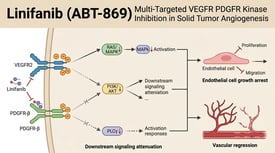
Vascular endothelial growth factor receptors (VEGFRs) are a family of receptor tyrosine kinases (RTKs) that serve as the primary regulators of angiogenesis, the process of new blood vessel formation. The family consists of three members: VEGFR-1 (Flt-1), VEGFR-2 (KDR/Flk-1), and VEGFR-3 (Flt-4). Among these, VEGFR-2 is the major mediator of the mitogenic, angiogenic, and permeability-enhancing effects of VEGF in endothelial cells, signaling through the MAPK/ERK, PI3K/Akt, and PLC-gamma pathways. VEGFR-3 is primarily involved in lymphangiogenesis. Pathological angiogenesis is a hallmark of cancer, as tumors require a dedicated blood supply to grow beyond a few millimeters and to metastasize.
Consequently, VEGFR signaling is a major therapeutic target in oncology. It is also a key driver in non-oncological conditions such as wet age-related macular degeneration (AMD) and diabetic retinopathy. The development of VEGFR inhibitors has been highly successful, resulting in numerous approved drugs. These are generally classified into three categories: monoclonal antibodies (mAbs) that target the VEGF ligand (e.g., bevacizumab) or the receptor (e.g., ramucirumab), small-molecule tyrosine kinase inhibitors (TKIs) that target the intracellular catalytic domain (e.g., sunitinib, sorafenib, axitinib, and pazopanib), and 'VEGF-trap' decoy receptors (e.g., aflibercept). TKIs are often multi-targeted, inhibiting other kinases like PDGFR and c-Kit, which can enhance efficacy but also increase toxicity.
Clinical progress in this field has transformed the treatment landscape for renal cell carcinoma, hepatocellular carcinoma, and colorectal cancer. However, the use of VEGFR inhibitors is associated with a distinct profile of adverse effects, including hypertension, proteinuria, fatigue, and hand-foot syndrome, which stem from the inhibition of VEGF signaling in normal vascular beds. Resistance to VEGFR-targeted therapy is a major clinical challenge and often occurs through the upregulation of alternative pro-angiogenic factors like FGF, PDGF, or angiopoietins, or through the recruitment of pro-angiogenic inflammatory cells. Current research strategies are focusing on combining VEGFR inhibitors with immune checkpoint inhibitors, as VEGF is known to have immunosuppressive effects in the tumor microenvironment. This combination has already shown significant clinical benefit in several tumor types.
Additionally, the development of highly selective next-generation TKIs and the exploration of biomarkers to predict response and toxicity are ongoing. As the field moves toward more personalized anti-angiogenic therapy, the integration of these agents into complex treatment regimens remains a cornerstone of modern oncology and ophthalmology.