TLR2-IN-C29 and Toxoplasma gondii Multilocus PCR-RFLP Genotyping in Wild Rodents
Copy code to add this image to your page
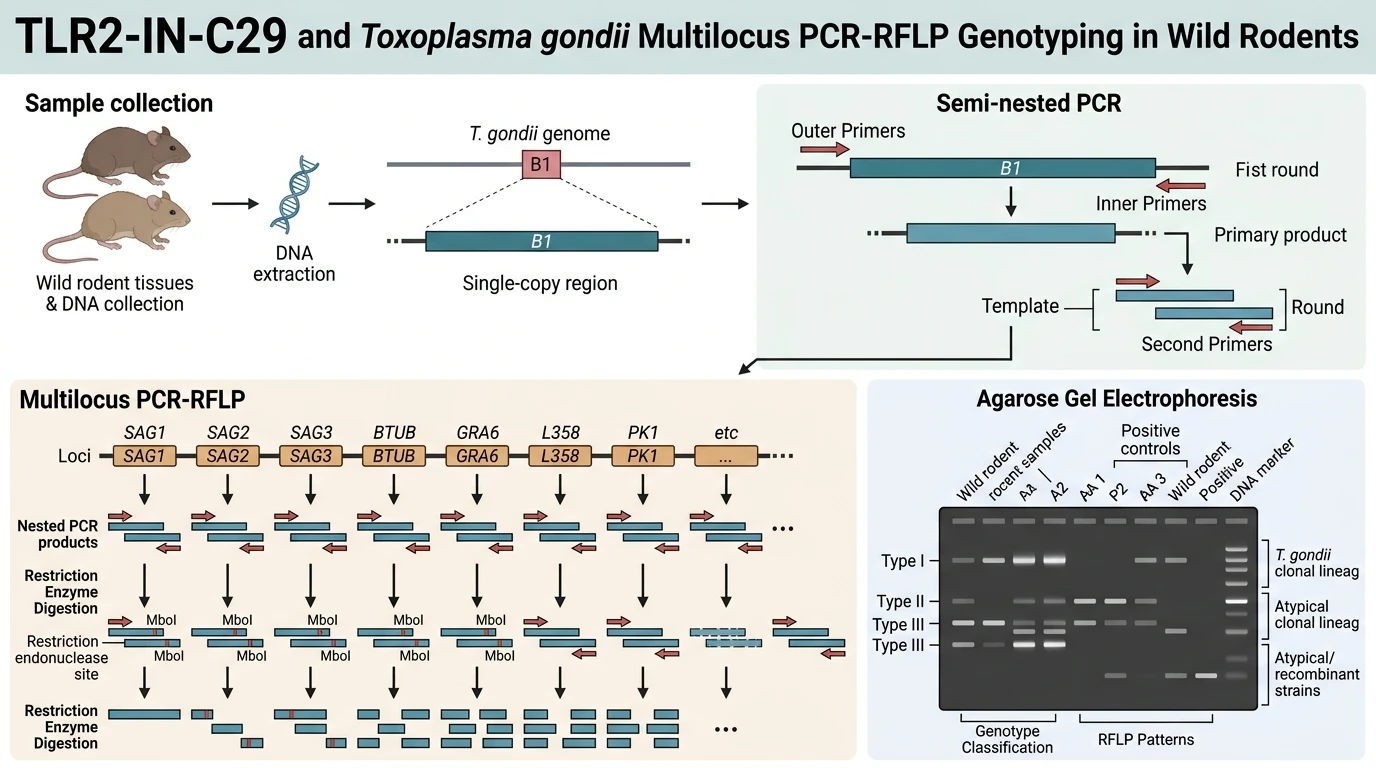
Molecular epidemiological investigation of apicomplexan parasites relies on sensitive diagnostic targets and robust genetic markers. Toxoplasma gondii infects a broad range of warm-blooded vertebrates, using wild rodents as primary intermediate hosts that maintain sylvatic transmission cycles. Evaluating parasite prevalence and population structure within wild reservoir species provides essential baseline data regarding environmental contamination and potential zoonotic risk. In a comprehensive survey conducted across Sichuan Province in southwestern China, researchers systematically sampled 181 brain tissues from five distinct wild rodent species to assess infection rates and genetic lineages.
Diagnostic detection utilized a semi-nested polymerase chain reaction (PCR) protocol targeting the highly conserved, repetitive B1 gene of T. gondii. The B1 gene repeat structure provides high analytical sensitivity, permitting detection even under conditions of low tissue parasitemia. Among the 181 analyzed rodent brain specimens, 6 samples yielded positive amplicons, corresponding to an overall prevalence of 3.31% within this specific regional cohort. While low relative to domestic livestock surveys, this positivity rate confirms active sylvatic circulation among wild rodent populations in southwestern China.
To further establish the genetic identities of the detected parasites, isolates underwent multilocus PCR-RFLP genotyping across 11 distinct polymorphic genetic loci: SAG1, SAG2, alt. SAG2, SAG3, BTUB, GRA6, L358, PK1, C22-8, C29-2, and Apico. Successful genotype determination requires high DNA yield across all target regions; consequently, complete 11-locus amplification profiles were successfully obtained for 4 of the 6 positive brain isolates. Digestion of amplified loci with target-specific restriction endonucleases revealed identical restriction fragment length polymorphism profiles across all 4 evaluated samples. Comparison with reference strain databases indicated that these isolates do not match standard clonal Type I, II, or III lineages, nor do they align with previously cataloged Chinese genotypes such as ToxoDB #9. Instead, the identical banding patterns point to a potential new genotype of T. gondii circulating in wild rodents in Sichuan Province.
In parallel host-pathogen interaction studies, small-molecule tools such as TLR2-IN-C29 serve as critical probes for dissecting pattern recognition receptor signaling during acute apicomplexan infection. Understanding host immune modulation by TLR signaling pathways, alongside rigourous molecular epidemiological profiling of parasitic zoonoses, helps clarify how host immunity shapes the evolution and distribution of atypical parasite genotypes in natural ecosystems.
Molecular Epidemiology and Multilocus Genotypic Profiling
Copy code to add this image to your page
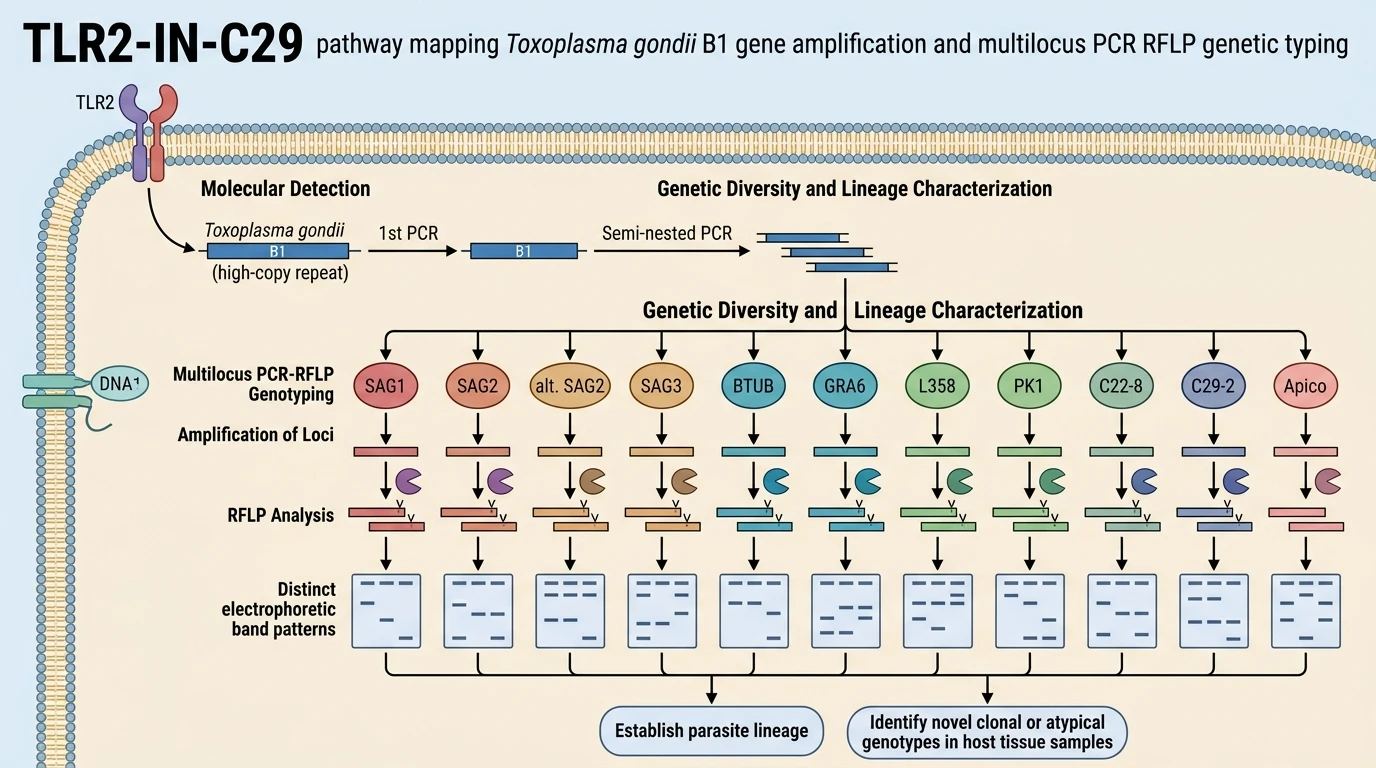
Semi-nested PCR amplifies the repetitive B1 gene to achieve sensitive detection of Toxoplasma gondii DNA in tissue samples. Amplicons undergo multilocus PCR-RFLP across 11 polymorphic loci (SAG1, SAG2, alt. SAG2, SAG3, BTUB, GRA6, L358, PK1, C22-8, C29-2, Apico). Specific restriction enzyme digestion produces characteristic band patterns that enable strain discrimination and novel genotype identification.
B1 Gene Amplification Identifies Low Host Parasitemia
Semi-nested PCR targeting the repetitive B1 gene achieved high diagnostic sensitivity in wild rodent tissues. Brain samples from 181 wild rodents yielded 6 positive amplifications (3.31%). Low tissue parasitemia often hinders direct parasite isolation. High-copy target sequences overcome this technical limitation. Experimental controls validated amplicon specificity; no false positives occurred in uninfected control tissues. Small-molecule probes like TLR2-IN-C29 help evaluate host inflammatory responses during such low-burden natural infections. These observations remain bounded by the sample size and regional scope of the field collection.
Multilocus RFLP Discriminates Atypical Sylvatic Lineages
Multilocus PCR-RFLP genotyping across 11 polymorphic loci resolved the genetic lineage of 4 rodent isolates. The targeted loci included SAG1, SAG2, alt. SAG2, SAG3, BTUB, GRA6, L358, PK1, C22-8, C29-2, and Apico. All 4 fully genotyped isolates exhibited identical restriction fragment patterns across all loci. This uniform profile indicates a shared, clonal origin among the sampled rodents. The observed restriction pattern differed from classical Type I, II, and III reference strains. Preliminary comparative analysis suggests a potential new genotype circulating in southwestern China. In immunobiological assays, TLR2-IN-C29 provides a pathway-specific baseline for measuring host innate responses to novel parasite strains.