FTY720 Hydrochloride S1P Receptor antagonist dynamic modulation of pathogenic central memory T cell egress
Copy code to add this image to your page
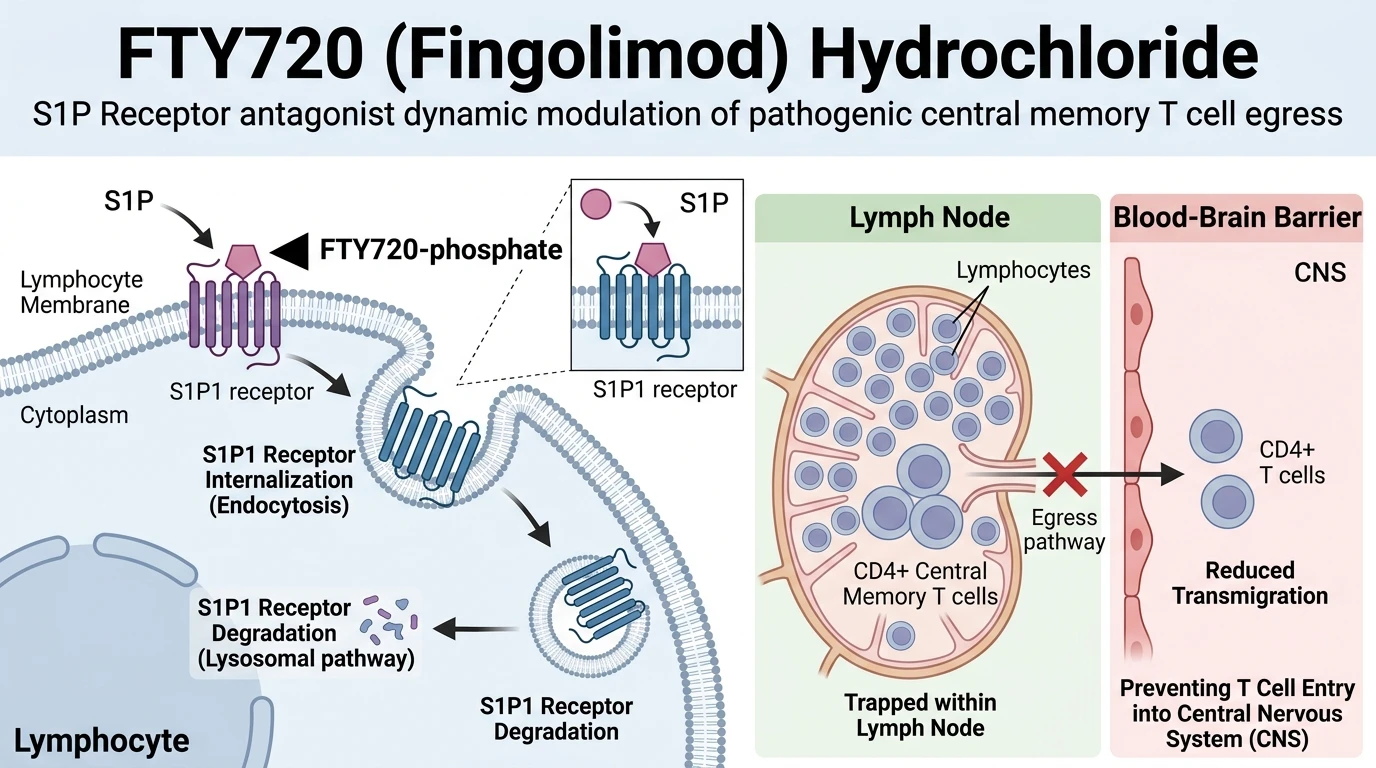
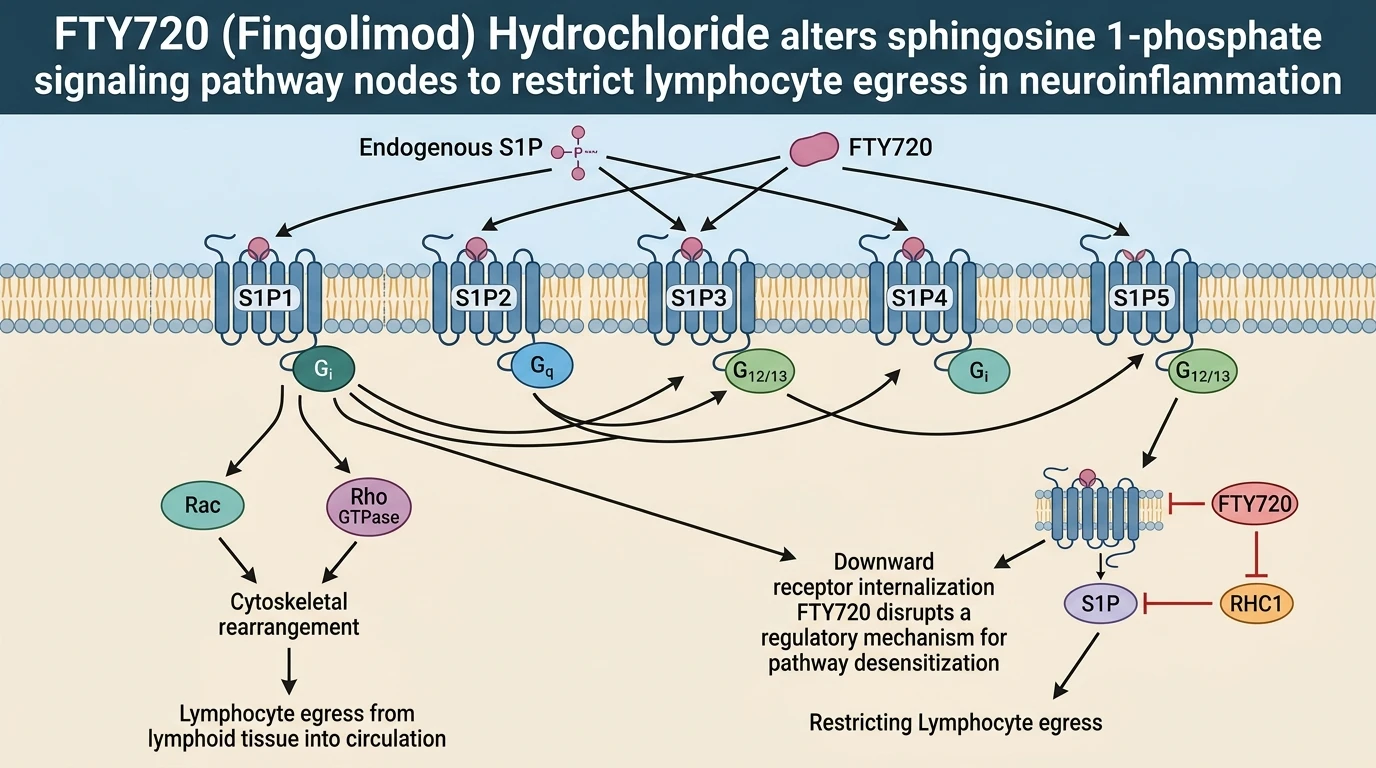
Sphingosine 1-phosphate (S1P) signaling pathways govern essential physiological processes including vascular development, endothelial barrier maintenance, and lymphocyte trafficking. Among the five identified G protein-coupled receptor subtypes (S1P1–S1P5), S1P1 plays a central role in guiding immune cell migration along an ascending S1P concentration gradient from lymphoid organs into peripheral blood and lymphatic vessels. FTY720 (Fingolimod) Hydrochloride represents a landmark structural analog of sphingosine that acts as a potent prodrug requiring in vivo phosphorylation by sphingosine kinase 2 (SphK2). The resulting active metabolite, FTY720-phosphate, functions as a high-affinity agonist at S1P1, S1P3, S1P4, and S1P5 receptors, while demonstrating no activity at S1P2.
Upon initial binding, FTY720-phosphate triggers transient receptor activation. However, unlike endogenous S1P, which induces reversible internalization followed by receptor recycling to the plasma membrane, FTY720-phosphate induces sustained S1P1 internalization and ubiquitin-proteasome-mediated degradation. This continuous down-modulation converts the initial agonist activity into functional antagonism. Lacking surface expression of S1P1, lymphocytes lose their ability to sense the S1P gradient between secondary lymphoid tissues and the circulation. Consequently, naïve T cells and CD4+ central memory T (TCM) cells remain trapped within lymph node parenchyma, unable to egress into peripheral systemic circulation. Detail regarding human biochemical signaling nodes can be further explored via sphingosine-1-phosphate receptor cascade annotations.
In the context of relapsing-remitting multiple sclerosis (MS), pathogenic CD4+ TCM cells express high levels of the chemokine receptor CCR7 and L-selectin (CD62L), enabling their entry into lymph nodes and subsequent transmigration across the blood-brain barrier into the central nervous system (CNS). By employing the FTY720 Hydrochloride S1P Receptor antagonist mechanism, central memory subsets are selectively sequestered within peripheral lymph nodes. In contrast, effector memory T (TEM) cells—which lack CCR7 and CD62L—do not routinely traffic through lymph node parenchyma and remain available in peripheral blood to maintain systemic immune surveillance against opportunistic pathogens.
Immunophenotypic profiling of peripheral blood mononuclear cells from MS patients under chronic therapy confirms marked alterations in circulating T cell subpopulation dynamics. Quantitative flow cytometry demonstrates sustained depletion of circulating CD4+ TCM and naïve T cell populations, alongside a relative enrichment of TEM and regulatory T cell (Treg) subsets. Notably, clinical responses vary among individual patients; clinical trials highlight that individuals experiencing breakthrough disease activity or relapse during therapy maintain distinct peripheral T cell profiles. Monitoring these specific cellular kinetics yields crucial predictive insight into treatment responsiveness and autoimmune disease progression.
Peripheral T Cell Dynamics and Relapse Prediction
Copy code to add this image to your page
FTY720 (Fingolimod) Hydrochloride undergoes phosphorylation in vivo to form an active ligand that targets S1P receptors. Binding to S1P1 triggers persistent receptor endocytosis and proteasomal degradation. This functional antagonism abolishes the gradient-driven egress of naïve T cells and CD4+ central memory T (TCM) cells from secondary lymphoid organs. Sequestering these pathogenic T cell subsets within lymph nodes prevents their transmigration across the blood-brain barrier, effectively suppressing neuroinflammatory disease progression.
Differential Subtype Shifts Under S1P Receptor Down-Modulation
Lymphocyte sequestration occurs rapidly following drug administration. In vivo phosphorylation of FTY720 (Fingolimod) Hydrochloride yields an active phosphate moiety that binds S1P1 with nanomolar affinity, triggering receptor endocytosis and proteasomal degradation. Circulating naive and TCM cell counts drop sharply within days. Conversely, effector memory T cell populations remain largely preserved in circulation due to their lack of lymph node homing receptors CCR7 and CD62L. Treg subsets expand relative to total circulating T cells. Under observed clinical conditions in relapsing-remitting multiple sclerosis cohorts, this functional shift establishes a distinct immunomodulatory profile that limits encephalitogenic T cell migration into the central nervous system.
Circulating CD4+ TCM Cell Percentages Predict Patient Relapse Propensity
Baseline cell dynamics do not fully dictate clinical response. Multiple sclerosis patients experiencing disease relapse during ongoing therapy exhibited markedly higher percentages of circulating CD4+ TCM cells at 3 and 6 months compared to stable, non-relapsing counterparts. Target engagement was evidently incomplete in these relapsing cohorts. Quantitative tracking of peripheral CD4+ central memory T cells using the FTY720 Hydrochloride S1P Receptor antagonist framework thus provides a robust biomarker for evaluating therapeutic coverage and predicting disease activity. Longitudinal bioanalytical monitoring remains essential for clinical optimization.