Adagrasib (MRTX849) Adagrasib Ras inhibitor Neoantigen Presentation in KRAS(G12C) Cancer
Copy code to add this image to your page
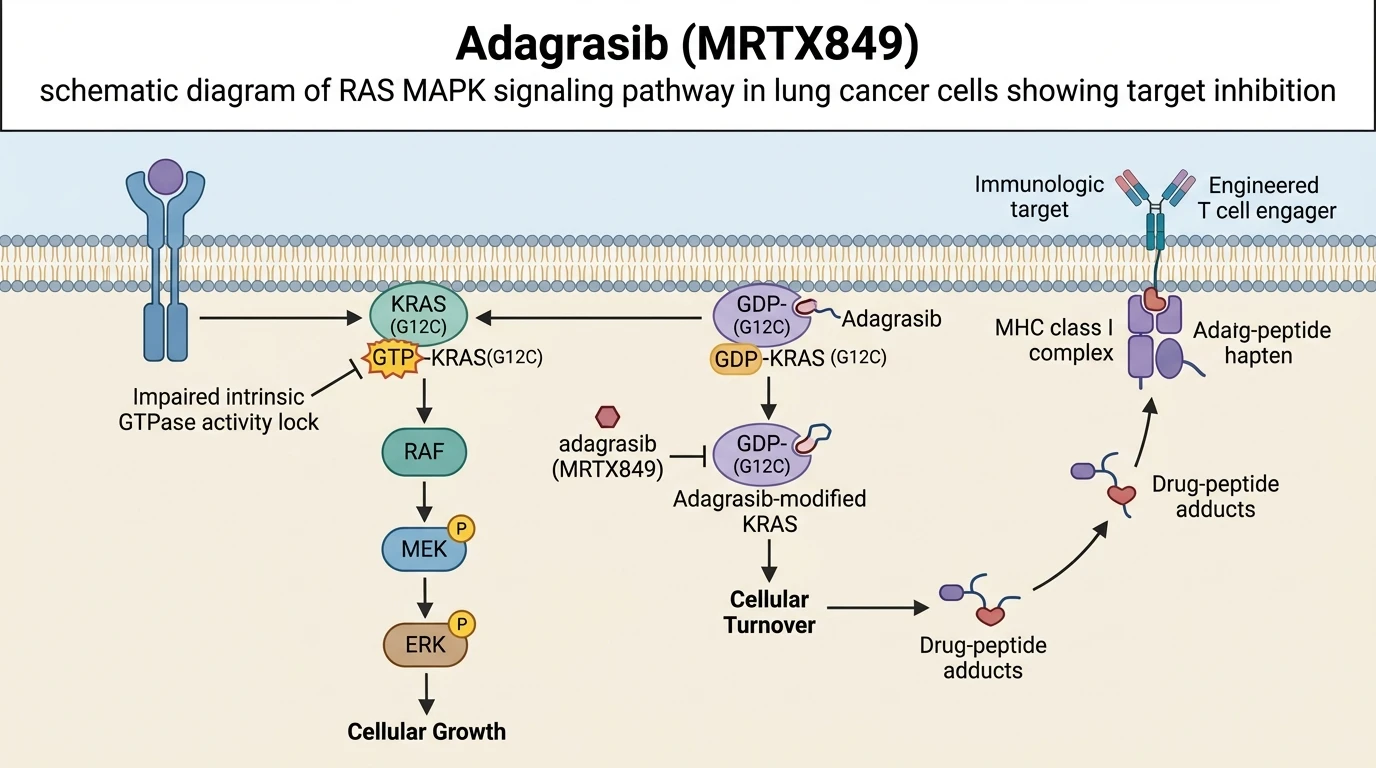
The oncogenic KRAS(G12C) mutation acts as a primary driver in approximately 13% of non-small cell lung cancers and 3% of colorectal adenocarcinomas. This single nucleotide transversion replaces glycine with cysteine at position 12, impairing intrinsic GTPase activity and rendering the protein refractory to GTPase-activating proteins. Consequently, KRAS remains predominantly bound to GTP, continuously driving downstream RAF-MEK-ERK and PI3K-AKT pathway cascades that fuel cell proliferation. Direct pharmacological targeting of KRAS was long considered intractable due to the picomolar binding affinity for GTP and an absence of deep hydrophobic pockets. The identification of a cryptic switch-II pocket accessible in the GDP-bound conformation enabled the development of mutant-selective covalent inhibitors.
Among these agents, the small molecule inhibitor adagrasib exhibits high potency and select target occupancy. Adagrasib (MRTX849) forms an irreversible covalent bond with the mutated cysteine-12 residue via nucleophilic addition of the cysteine thiol to the drug's electrophilic acrylamide motif. By locking KRAS(G12C) in its inactive GDP-bound state, the compound prevents RAF effector recruitment and inhibits downstream MAP kinase signaling. Despite clinical efficacy in lung and colorectal cancers, therapeutic duration is constrained by rapid emergence of resistance. Cancer cells frequently bypass direct target inhibition through secondary KRAS mutations, receptor tyrosine kinase amplification, or reactivation of parallel signaling cascades.
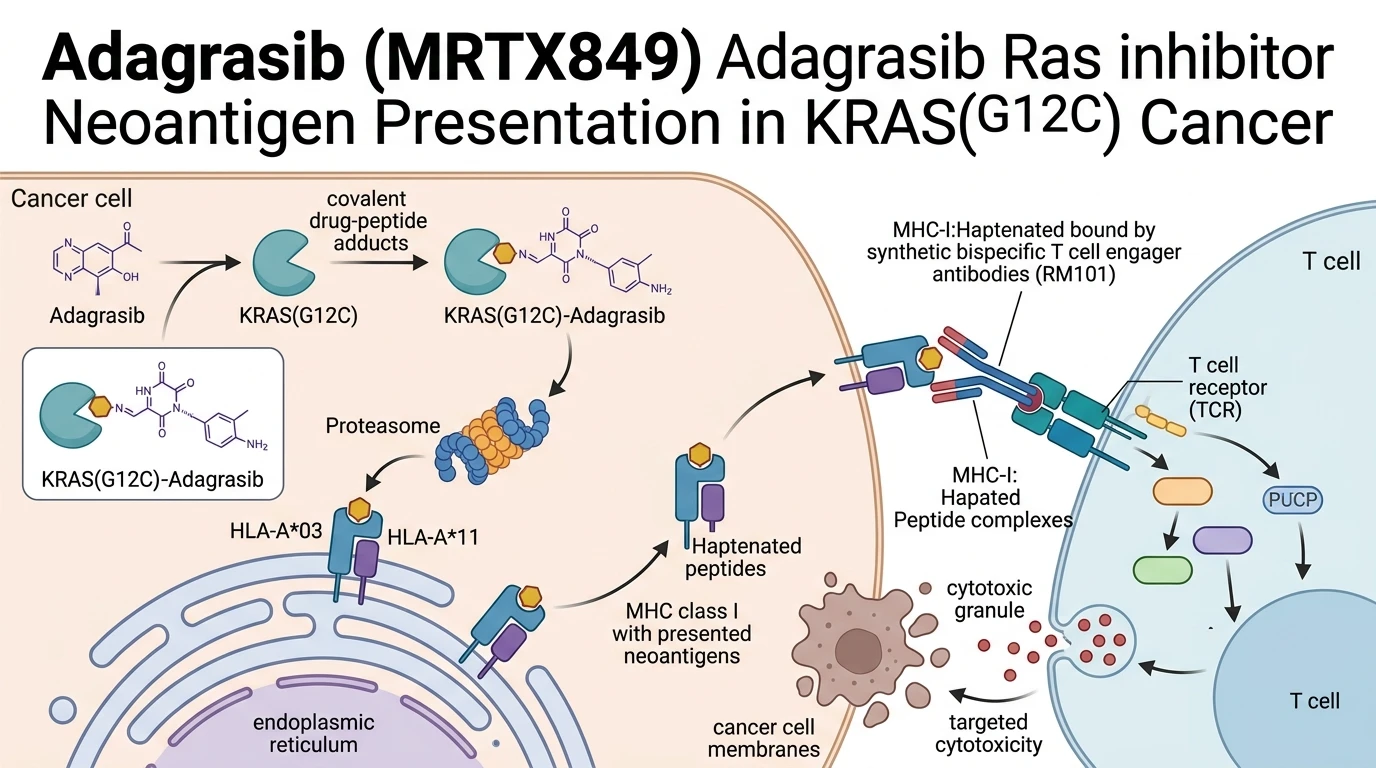
The HapImmune paradigm overcomes resistance by repurposing targeted covalent inhibitors into immunological targets. When Adagrasib (MRTX849) binds intracellular KRAS(G12C), the resulting drug-protein adduct enters the natural antigen processing pathway. Standard proteasomal turnover degrades the modified KRAS protein into smaller peptide fragments. Specific cleavage events yield nonamer peptides harboring the adagrasib-conjugated cysteine residue. These drug-modified peptides are imported into the endoplasmic reticulum via the transporter associated with antigen processing system. Within the lumen, chaperone proteins facilitate the loading of haptenated peptides onto nascent MHC class I molecules.
The adagrasib-peptide/HLA complexes are subsequently presented on the cell surface as novel, tumor-specific neoantigens. Human leukocyte antigen alleles HLA-A03:01 and HLA-A11:01, present in approximately 30% of the human population, efficiently display these haptenated peptides. Using phage display selections against adagrasib-peptide/HLA complexes, researchers engineered human synthetic antibodies. Initial candidate RM010 and its affinity-matured derivative RM101 demonstrated exquisite specificity for the adagrasib-modified peptide presented on HLA-A03 and HLA-A11. Crucially, free adagrasib in solution does not block antibody binding to the surface peptide-MHC complex at physiologically relevant concentrations.
Engineering RM101 into a bispecific T cell engager format creates a direct link between cytotoxic T lymphocytes and drug-treated tumor cells. The bispecific molecule simultaneously binds the adagrasib-peptide/HLA complex on cancer cells and the CD3 subunit on T cells. This immunological synapse formation triggers polyclonal T cell activation, granzyme release, and perforin-mediated target cell destruction. Structural studies reveal that RM010 forms extensive contact surfaces with both the hapten moiety of adagrasib and the surrounding HLA heavy chain framework. Cellular assays confirm that adagrasib concentration and incubation duration directly correlate with surface neoantigen density. Even in target cells exhibiting diminished sensitivity to growth arrest by the Adagrasib Ras inhibitor, surface presentation of the drug-peptide adduct remains sufficient for robust T cell-mediated killing.
Structural Characterization and Bispecific T Cell Engager Cytotoxicity
Copy code to add this image to your page
Adagrasib (MRTX849) covalently binds mutated cysteine-12 in KRAS(G12C), blocking oncogenic signaling. Cellular proteasomal processing degrades these drug-protein adducts into haptenated peptides presented on HLA-A03 and HLA-A11 MHC class I complexes. Synthetic bispecific T cell engagers (RM101) selectively recognize these presented adagrasib-peptide/HLA complexes without competitive inhibition by free adagrasib. Engager binding recruits CD3+ T cells to induce selective, HLA-dependent cytotoxicity against adagrasib-resistant lung cancer cells, establishing covalent drug-peptide/MHC complexes as actionable neoantigens for targeted immunotherapy.
Structural Basis of Hapten Recognition and Selectivity
Cryo-EM structural analysis of RM010 bound to the adagrasib-peptide/HLA-A*11 complex reveals a unique mode of target engagement. Steric fitting prevents cross-reactivity with untargeted host proteins. The antibody Fab fragment cradles the solvent-exposed adagrasib hapten within a deep hydrophobic pocket formed by its complementarity-determining regions. Extensive hydrogen bonding and van der Waals interactions stabilize the complex; simultaneously, direct contacts with the HLA heavy chain backbone ensure strict allele specificity. Unbound Adagrasib Ras inhibitor in surrounding media does not compete with the presented adduct due to distinct steric constraints within the antibody paratope. The structural orientation differs significantly from sotorasib-directed antibodies, demonstrating that distinct covalent inhibitors generate unique immunogenic epitopes.
RM101 Bispecific Engagers Induce Targeted HLA Dependent Cytotoxicity
To convert neoantigen recognition into effective immune destruction, RM101 was reformatted into a bispecific T cell engager molecule. Cellular viability dropped sharply. In co-culture assays with human peripheral blood mononuclear cells, RM101 induced rapid, dose-dependent killing of adagrasib-pretreated KRAS(G12C) lung cancer cells. Unmodified parental cells lacking drug exposure remained entirely uninjured. Cytotoxic activity strictly required expression of matched HLA alleles, specifically HLA-A03:01 or HLA-A11:01. Crucially, RM101 maintained potent lytic activity against lung cancer lines displaying acquired resistance to the Adagrasib Ras inhibitor, confirming that target presentation remains intact despite signaling bypass.
Covalent Drug Adducts Provide Actionable Cancer Specific Neoantigens
These empirical findings demonstrate that targeted covalent inhibitors can serve dual therapeutic functions within the cell. Target clearance depended strictly on HLA allele matching. Beyond direct target inactivation, small molecule binding yields chemically defined haptens for MHC class I presentation. The resulting drug-peptide/HLA complexes act as highly tumor-specific targets for bispecific antibody construct engagement. Observations in these cellular models confirm that covalent target modification can effectively bridge direct kinase inhibition with precision immunotherapy.