Nafamostat mesilate (FUT-175) Nafamostat mesilate inhibitor for TMPRSS2 Target Engagement and Nanoparticle Delivery
Copy code to add this image to your page
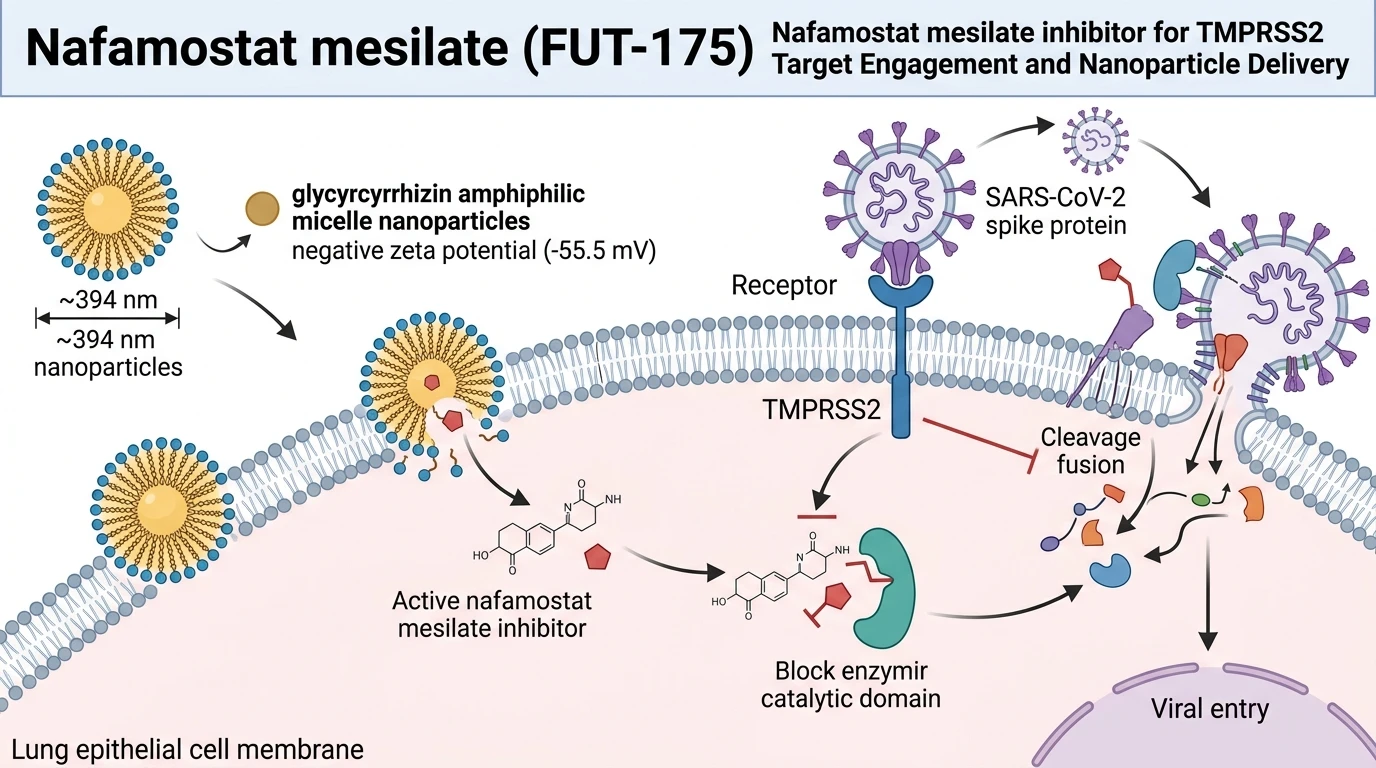
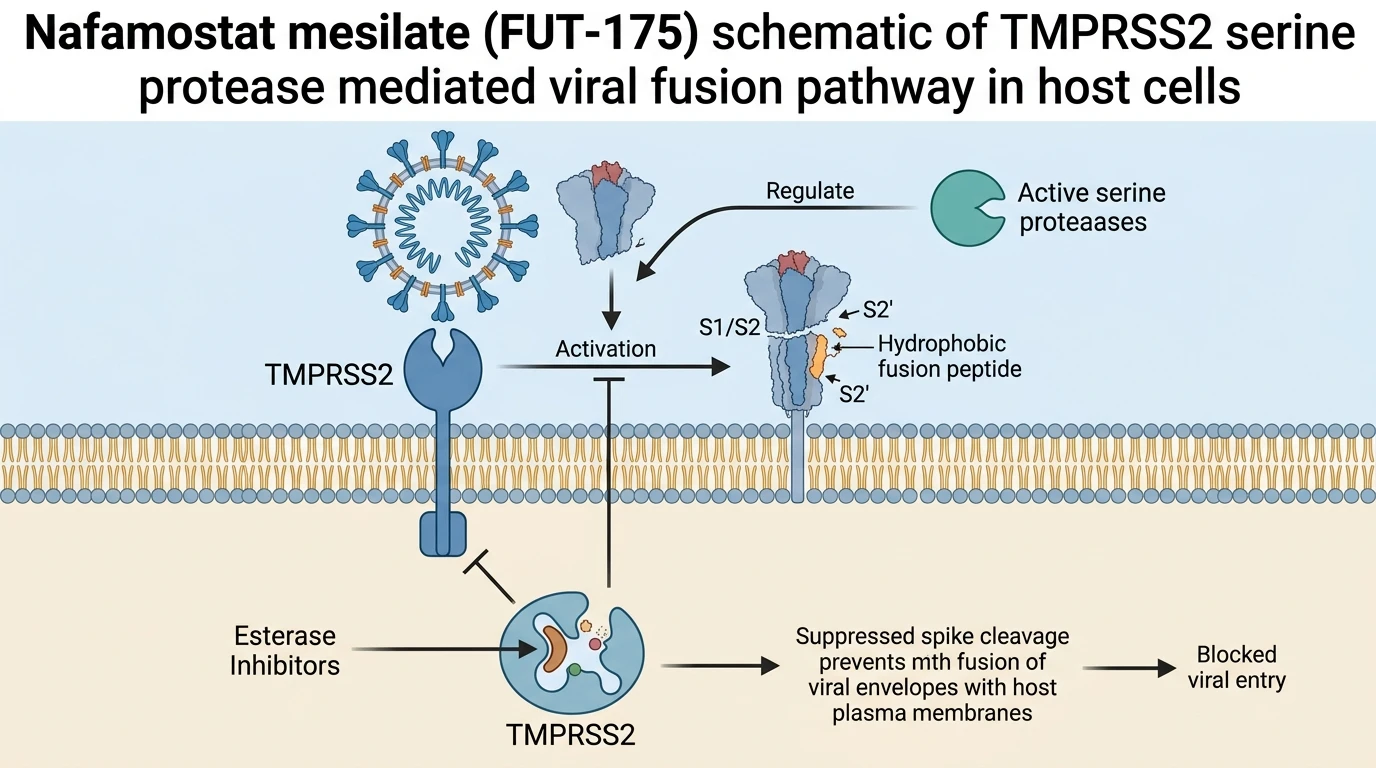
Host cell entry by SARS-CoV-2 relies strictly on proteolytic priming of the viral spike glycoprotein. Transmembrane serine protease 2 (TMPRSS2) catalyzes critical cleavage events at the S1/S2 and S2' processing sites. This processing exposes the hydrophobic fusion peptide necessary for lipid bilayer merging. Direct catalytic inhibition of TMPRSS2 represents a validated antiviral intervention strategy. Nafamostat mesilate (FUT-175) functions as a potent, broad-spectrum serine protease inhibitor capable of suppressing TMPRSS2 activation at low nanomolar concentrations. Biochemical assays confirm that the compound forms a transient guanidino-benzoate acyl-enzyme complex with the active-site serine residue within the catalytic triad. This covalent interaction halts proteolytic processing of membrane-anchored viral glycoproteins. Similar to target interactions observed in small molecule protease inhibitors, precise active site occupancy governs target residence time and functional potency.
Despite high intrinsic enzyme affinity, clinical translatability of free nafamostat mesilate remains constrained by rapid systemic clearance and esterase hydrolysis in human plasma. The active compound exhibits an elimination half-life of less than eight minutes in circulation. Rapid ester bond cleavage yields inactive metabolic side products, severely curtailing target tissue accumulation. High-dose intravenous infusions carry significant risk of systemic off-target coagulopathies due to non-specific inhibition of circulating thrombin, plasmin, and factor Xa. Direct pulmonary administration or localized protection of the active ester moiety is therefore mandatory to achieve therapeutic efficacy in airway epithelial tissues.
To overcome these pharmacokinetic barriers, a novel computational framework termed Carrier Suitability Scoring (CSS) was deployed to identify ideal drug delivery system (DDS) carrier candidates from virtual chemical libraries. Virtual screening across DrugBank databases evaluated amphiphilic small molecules for structural compatibility, self-assembly thermodynamics, and target protection capabilities. Glycyrrhizin, a triterpene saponin derivative, scored highest among candidate matrices. Its lipophilic glycyrrhetinic acid core facilitates hydrophobic core formation, while dual glucuronic acid residues present a highly charged hydrophilic outer shell. This structural architecture enables spontaneous micellar self-assembly around hydrophobic guest molecules, offering robust encapsulation for fragile ester linkage compounds.
Formulation of NM-loaded micelle nanoparticles (NPs) via thin-film hydration yielded stable nanostructures. Nanoparticle characterization demonstrated uniform spherical morphology with a mean hydrodynamic diameter of approximately 394 nm. Dynamic light scattering confirmed moderate monodispersity suitable for mucosal pulmonary retention. The surface charge profile exhibited an impressive zeta potential of -55.5 mV. High negative surface charge induces electro-repulsive forces that prevent nanoparticle aggregation and physical instability in liquid suspensions. Furthermore, quantitative HPLC analysis demonstrated an encapsulation efficiency exceeding 90%, establishing efficient drug retention within the hydrophobic saponin core.
In vitro evaluation using human lung epithelial cell lines verified the biological safety profile of the nanoformulation. Free and micellar drug forms maintained cellular viability across extended incubation windows, confirming non-cytotoxicity at pharmacologically active concentrations. Encapsulation significantly attenuated esterase hydrolysis in plasma models, preserving the integrity of the active ester moiety. As a result, the Nafamostat mesilate inhibitor formulation retained persistent anti-proteolytic activity against cell-surface TMPRSS2, blocking membrane fusion cascades in vitro. These empirical findings demonstrate that micellar nanocarriers effectively rescue labile protease inhibitors from rapid degradation.
Nanocarrier Characterization and Pharmacological Evaluation
Copy code to add this image to your page
Nafamostat mesilate inhibits TMPRSS2 serine protease activity by forming a acyl-enzyme complex at the catalytic triad, blocking viral spike cleavage and membrane fusion. To circumvent rapid plasma hydrolysis, the compound was encapsulated within glycyrrhizin amphiphilic micelle nanoparticles via Carrier Suitability Scoring. The ~394 nm spherical nanoparticles exhibit high zeta potential (-55.5 mV) and >90% loading efficiency, stabilizing the ester bond against degradation while maintaining non-cytotoxicity in lung epithelial cells.
Computational Screening Identifies Glycyrrhizin as Micellar Matrix
Screening of amphiphilic matrices required rigorous evaluation of structural compatibility and assembly thermodynamics. The Carrier Suitability Scoring (CSS) algorithm evaluated molecular descriptors across candidate databases. Glycyrrhizin achieved the top suitability ranking. Its hydrophobic triterpenoid core drives spontaneous self-assembly in aqueous environments. Concurrently, polar glucuronic acid groups project outward to construct a protective hydrophilic shell. Physical mixture studies confirmed strong non-covalent interactions between the guest molecule and carrier backbone. Hydrophobic forces stabilize the core complex. Consequently, this nanostructure shielding protects the vulnerable ester bond of the Nafamostat mesilate inhibitor against active plasma esterases under physiological conditions.
Physicochemical Stability and High Encapsulation Yields
Formulation parameters directly determined nanoparticle size and structural uniformity. Dynamic light scattering established a mean particle diameter of 394 nm. Electrophoretic mobility measurements yielded a highly negative zeta potential of -55.5 mV. High surface charge prevents particle coalescence through electrostatic repulsion. Aggregate formation remained absent over multi-week storage testing at 4°C. High-performance liquid chromatography confirmed drug loading efficiencies above 90%. High entrapment rates prevent premature drug leakage in circulating media. Thus, physical nanocarrier stability correlates with extended chemical protection of the loaded payload.
Attenuation of Proteolytic Priming in Lung Epithelium
Target engagement was verified in human airway cell culture assays. Micellar delivery delivered intact inhibitor directly to host membrane surfaces. The active compound engaged the catalytic triad of TMPRSS2. Proteolytic processing of viral spike structures was quantitatively blocked. Cellular toxicity remained undetected across tested dosage ranges in Calu-3 cell monolayers. Cell viability exceeded 95% following 24-hour treatment exposures. The Nafamostat mesilate inhibitor formulation successfully preserved active drug structure while eliminating cell toxicity. Overall, these observations demonstrate that saponin-based nanocarriers provide a viable pathway for aerosolized pulmonary administration.