Tegatrabetan (BC-2059) Suppresses CDH4-Driven Wnt β-Catenin Signaling in Papillary Thyroid Carcinoma
Copy code to add this image to your page
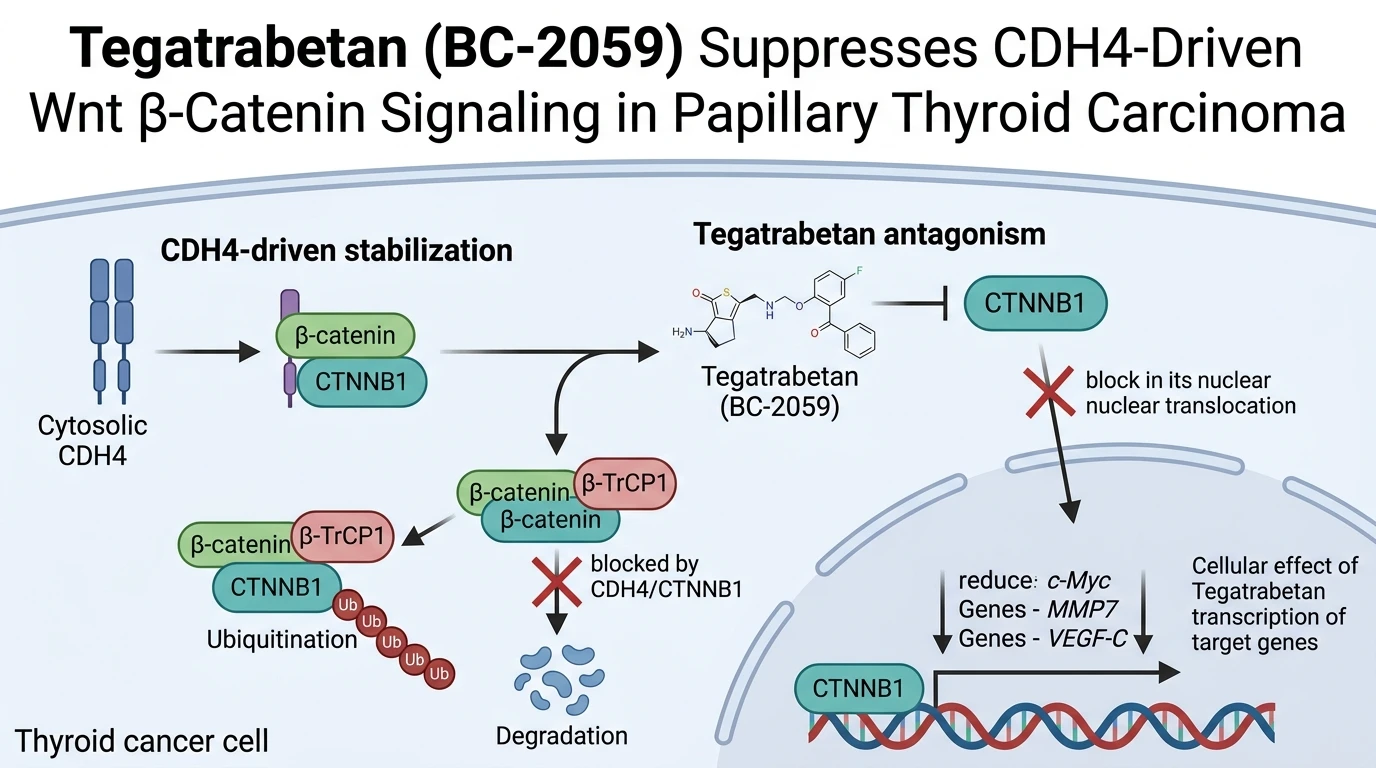
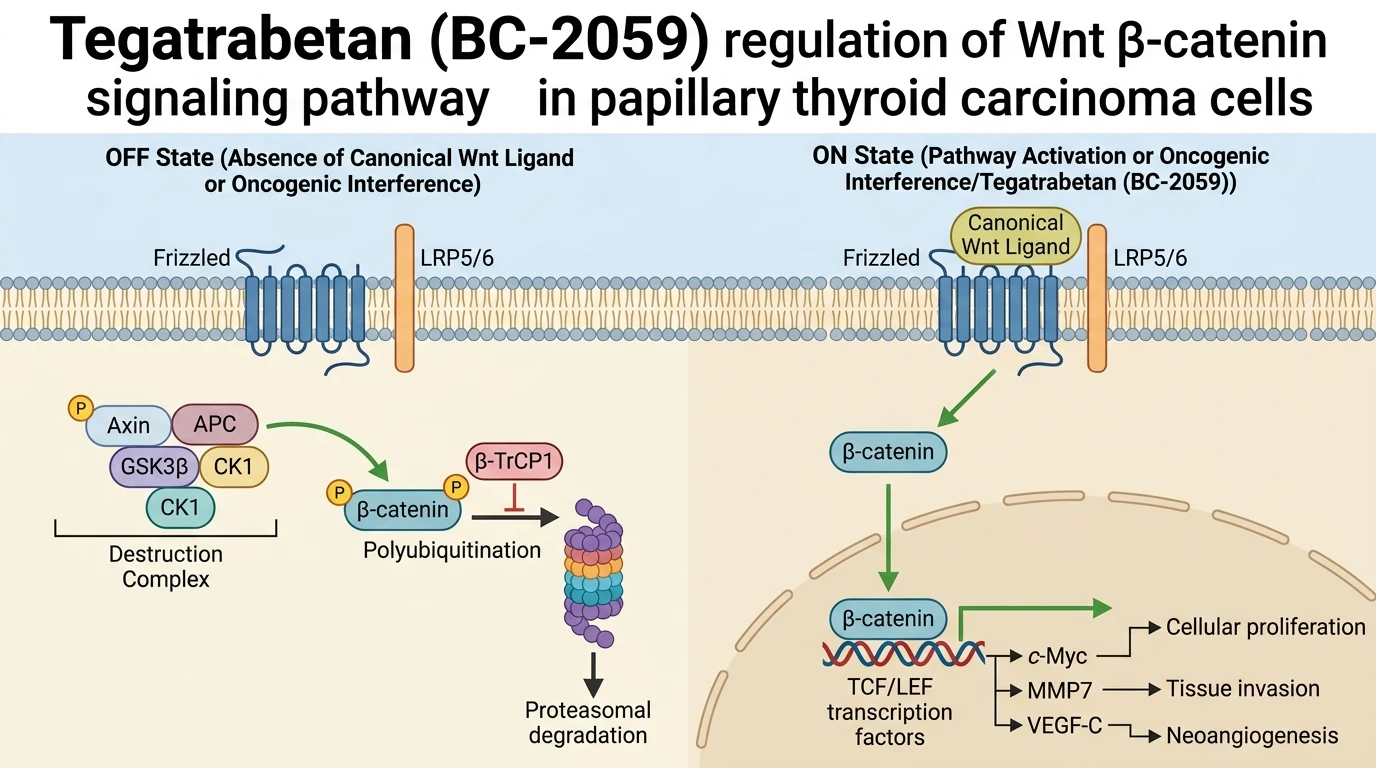
Papillary thyroid carcinoma (PTC) driven by abnormal intracellular signaling exhibits complex invasive properties. Cadherin 4 (CDH4), traditionally recognized as a transmembrane cell-cell adhesion molecule, displays atypical cytosolic accumulation in aggressive PTC subtypes. Under physiological conditions, canonical Wnt signaling maintains low baseline levels of free β-catenin (CTNNB1). A cytosolic destruction complex composed of Axin, adenomatous polyposis coli (APC), glycogen synthase kinase 3β (GSK3β), and casein kinase 1 (CK1) phosphorylates β-catenin. This modification marks β-catenin for recognition by the E3 ubiquitin ligase subunit β-TrCP1, driving rapid 26S proteasomal degradation. In cytosolic CDH4-overexpressing PTC cell models, this homeostatic control breaks down. Cytosolic CDH4 physically binds β-catenin, sterically impeding its association with β-TrCP1. Proteasomal turnover slows dramatically. Unbound cytosolic β-catenin accumulates and translocates to the nucleus.
Inside the nucleus, β-catenin associates with T-cell factor/lymphoid enhancer factor (TCF/LEF) transcription factors. This complex recruits co-activators to drive the transcription of specific oncogenic target genes. Experimental profiling reveals marked upregulation of c-Myc, matrix metalloproteinase-7 (MMP7), and vascular endothelial growth factor C (VEGF-C). Increased c-Myc expression drives aberrant cell cycle progression. Matrix digestion by MMP7 accelerates extracellular matrix degradation, facilitating cell migration and tissue invasion. Concurrently, VEGF-C secretion stimulates endothelial cell sprouting and tube formation. This coordinated molecular response fosters primary tumor enlargement, local microvascular expansion, and distant metastatic dissemination.
Pharmacological intervention at the level of β-catenin target engagement represents a direct strategy to suppress this oncogenic cascade. Tegatrabetan (BC-2059) is a potent, small-molecule β-catenin antagonist that targets the interaction between β-catenin and its nuclear transcriptional machinery. By selectively blocking β-catenin-dependent transcriptional assembly, Tegatrabetan disrupts downstream gene activation regardless of upstream stabilizing mutations or CDH4 overexpression. In preclinical evaluation, treatment with Tegatrabetan decreases intranuclear β-catenin occupancy at promoter regions of c-Myc, MMP7, and VEGF-C.
Phenotypic assays confirm the functional consequences of this inhibition. In cultured PTC lines, application of Tegatrabetan (BC-2059) reduces cell migration speed and suppresses transwell invasion in a dose-dependent manner. In human umbilical vein endothelial cell (HUVEC) co-culture systems, conditioned media from Tegatrabetan-treated CDH4-overexpressing cells fails to induce robust capillary tube network formation. In vivo experiments using orthotopic and tail-vein injection murine models further validate these findings. Systemic administration of Tegatrabetan (BC-2059) significantly reduces primary xenograft tumor volume and decreases the incidence of pulmonary metastatic foci without overt host toxicity. These empirical observations establish Tegatrabetan as an effective agent for inhibiting CDH4-mediated oncogenesis in PTC experimental systems.
Pharmacological Evaluation and Target Pathway Characterization
Copy code to add this image to your page
Cytosolic Cadherin 4 (CDH4) is overexpressed in papillary thyroid cancer, where it binds β-catenin and impedes β-TrCP1-mediated polyubiquitination and proteasomal degradation. The resulting cytosolic accumulation drives β-catenin nuclear translocation and downstream transcription of c-Myc, MMP7, and VEGF-C, promoting migration, invasion, angiogenesis, and metastasis. Tegatrabetan (BC-2059) acts as a potent β-catenin antagonist that restores pathway regulation, systematically suppressing CDH4-induced transcriptional activity and reversing invasive phenotypes both in vitro and within murine xenograft models.
Cytosolic CDH4 Accumulation Inhibits Proteasomal β-Catenin Degradation
Cytosolic CDH4 acts as an unexpected regulator of β-catenin stability in papillary thyroid cancer cells. Under baseline conditions, free β-catenin undergoes continuous phosphorylation and ubiquitin-mediated degradation. The E3 ubiquitin ligase adaptor β-TrCP1 executes this regulatory step. In CDH4-overexpressing cellular contexts, cytosolic CDH4 directly complexes with β-catenin. Co-immunoprecipitation assays demonstrate that this physical association sterically blocks β-TrCP1 binding. Consequently, β-catenin polyubiquitination drops substantially. The un-degraded protein accumulates within the cytoplasm and subsequently migrates into the nuclear compartment.
Tegatrabetan Suppresses Downstream Transcriptional Activation and Endothelial Tube Formation
Nuclear β-catenin drives the transcription of critical oncogenic effectors. Key downstream targets include c-Myc, MMP7, and VEGF-C. In vitro reporter assays indicate high baseline activity of TCF/LEF promoters in CDH4-rich thyroid cancer cells. Tegatrabetan directly antagonizes β-catenin-dependent transcription. Administration of this compound downregulates c-Myc transcript levels within six hours of exposure. Downstream protein expression of MMP7 and VEGF-C subsequently decreases. In endothelial co-culture models, conditioned media from treated cells fails to induce capillary-like tubulogenesis. Matrix metalloproteinase activity drops in parallel.
Attenuation of Primary Tumor Growth and Metastatic Spread in Xenograft Models
Validation of therapeutic efficacy required evaluation within animal tumor models. In murine xenograft models bearing CDH4-overexpressing PTC cell implants, tumor volume was monitored over four weeks. Tegatrabetan treatment led to marked suppression of primary tumor expansion compared to vehicle controls. Microvascular density within excised tumor tissue decreased substantially upon treatment. Furthermore, in intravenous tail-vein injection models, treatment reduced the total number of pulmonary metastatic nodules. Histological analysis confirmed reduced expression of nuclear β-catenin within residual host tissue.