KD025 (Belumosudil) and KD025 from Selleck Inhibit ROCK2 in Steroid-Refractory Chronic Graft-Versus-Host Disease
Copy code to add this image to your page
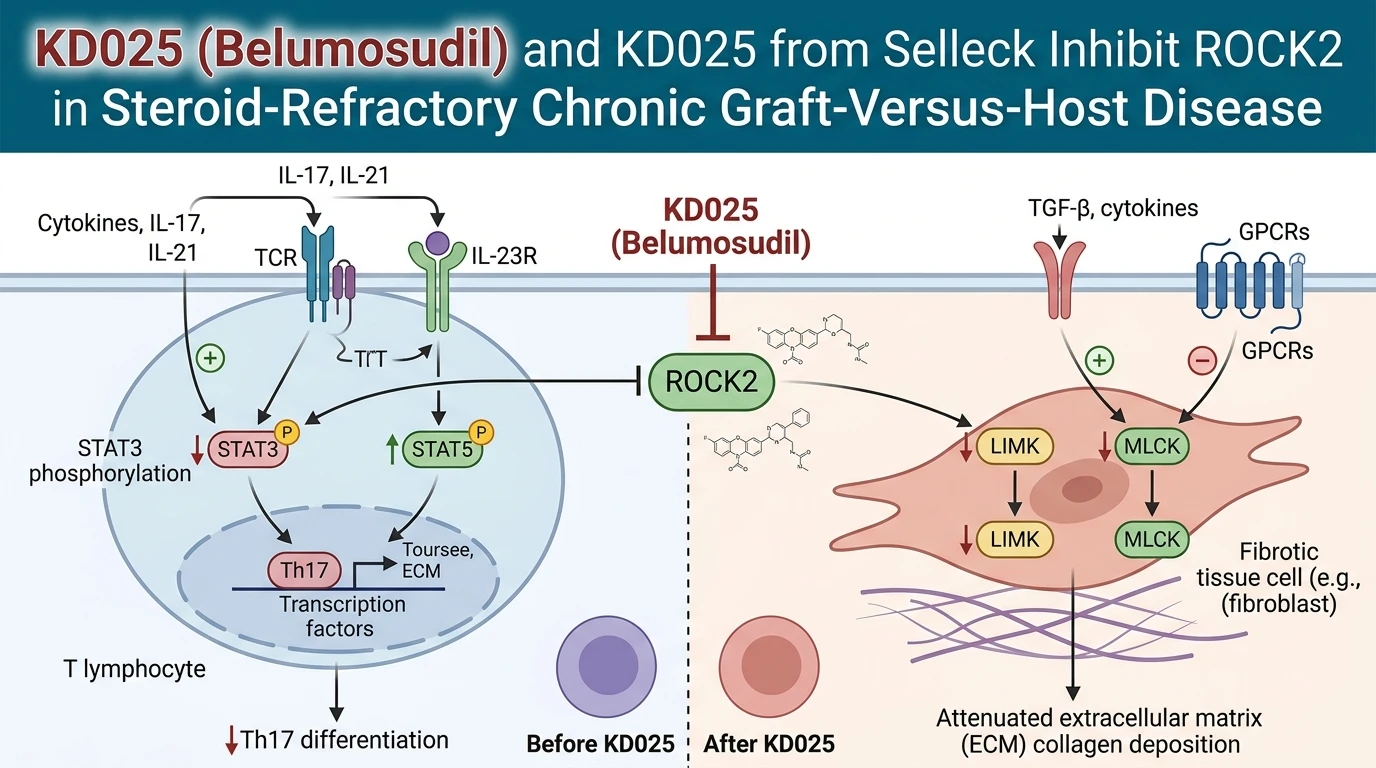
Steroid-refractory chronic graft-versus-host disease (SR-cGvHD) presents a complex immunological and fibrotic pathology following allogeneic hematopoietic stem cell transplantation. Chronic GvHD manifests through systemic immune dysregulation and progressive organ fibrosis, driven by imbalanced T-helper cell subsets and aberrant tissue remodeling. Central to these pathogenic mechanisms is Rho-associated protein kinase 2 (ROCK2), a serine/threonine kinase activated downstream of the small GTPase RhoA. Selective inhibition of ROCK2 offers a targeted therapeutic approach by dual-regulating immune responses and fibrotic cascades, bypassing the widespread immunosuppression associated with conventional therapies.
In clinical evaluations of SR-cGvHD, KD025 (Belumosudil) functions as an oral selective inhibitor of ROCK2. Biochemical assays demonstrate that KD025 inhibits ROCK2 with approximately 100-fold higher selectivity over the closely related isoform ROCK1. This isoform selectivity remains clinically critical because ROCK1 inhibition is linked to cardiovascular toxicity and systemic hypotension, whereas selective ROCK2 target engagement preferentially modulates immune cell differentiation and fibrotic gene expression. By binding the ATP-binding pocket of ROCK2, KD025 blocks the phosphorylation of key downstream targets, including STAT3, LIM domain kinase 2 (LIMK2), and myosin light chain (MLC).
A systematic meta-analysis incorporating 313 patients across four clinical studies evaluated the clinical efficacy and safety of KD025 (Belumosudil) in SR-cGvHD cohorts. The pooled analyses revealed a best overall response rate (ORR) of 73% (95% CI: 68%–78%), demonstrating robust therapeutic activity in heavily pretreated patient populations who had failed multiple prior systemic lines. Furthermore, the pooled 12-month failure-free survival (FFS) reached 57% (95% CI: 51%–63%). Failure-free survival, defined as the absence of death, non-relapse mortality, therapeutic switch, or disease progression, highlights sustained disease stabilization under continuous ROCK2 inhibition.
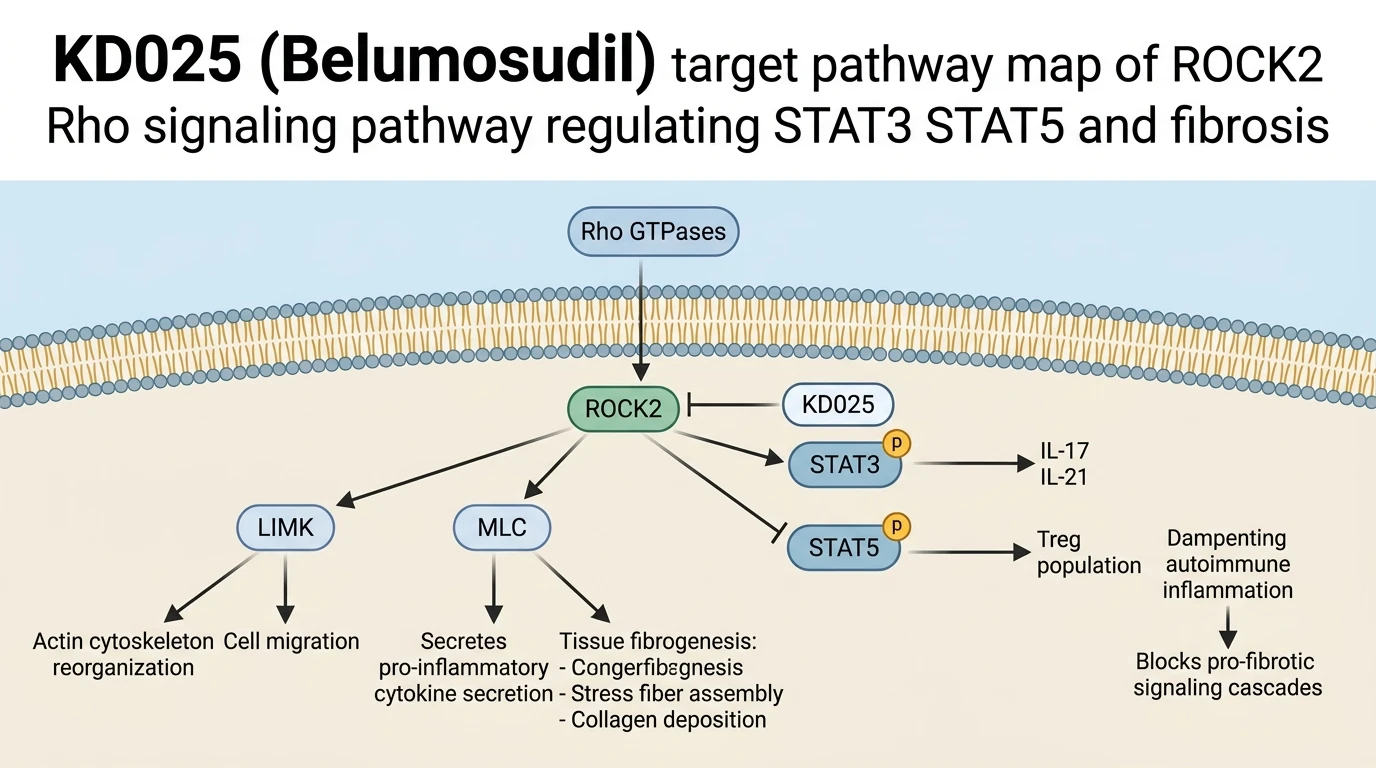
The pharmacodynamic mechanism of KD025 from Selleck hinges on restoring immune homeostasis through the reciprocal modulation of STAT3 and STAT5 transcription factors. Elevated ROCK2 activity in inflammatory states skews CD4+ T-cell differentiation toward pathogenic Th17 and Th22 lineages by enhancing STAT3 phosphorylation. Concurrently, ROCK2 activity dampens STAT5 phosphorylation, suppressing the generation and suppressive function of FOXP3+ regulatory T cells (Tregs). Administration of KD025 from Selleck diminishes STAT3 phosphorylation while preserving or enhancing STAT5 activation. This rebalancing normalizes the Th17/Treg ratio, suppressing pro-inflammatory cytokine output—including IL-17A, IL-17F, and IL-21—without inducing global lymphopenia.
Beyond immunomodulatory signaling, KD025 (Belumosudil) exerts direct antifibrotic effects across multiple organ systems. Fibrosis in cGvHD involves the activation and transdifferentiation of quiescent fibroblasts into alpha-smooth muscle actin (α-SMA)-positive myofibroblasts. ROCK2 signaling directly drives myofibroblast contractility and extracellular matrix synthesis via LIMK phosphorylation and subsequent cofilin inactivation. Pharmacological blockade of ROCK2 stops stress fiber formation, decreases TGF-β-mediated fibrogenesis, and downregulates collagen type I production. This dual immunomodulatory and antifibrotic mechanism positions Belumosudil as a targeted therapy for manifestations involving advanced tissue sclerosis.
In clinical presentations, lung involvement such as bronchiolitis obliterans syndrome (BOS) represents a refractory and high-mortality complication of cGvHD. The inflammatory and fibrotic obstruction of small airways in BOS responds poorly to traditional calcineurin inhibitors or corticosteroids. Data from the meta-analysis indicate that patients with severe pulmonary involvement achieved notable stabilization and symptomatic improvement following treatment with KD025 (Belumosudil). By halting both the immunological drive and local fibrotic tissue remodeling within the bronchial microenvironment, selective ROCK2 inhibition provides a molecular rationale for addressing pulmonary cGvHD manifestations.
Therapeutic Evaluation and Pharmacological Characterization
Copy code to add this image to your page
KD025 (Belumosudil) selectively inhibits ROCK2 kinase activity, altering downstream STAT3 and STAT5 phosphorylation balances. This dual mechanism diminishes Th17 and Th22 pro-inflammatory cytokine production while preserving regulatory T-cell populations. Concurrently, inhibition of ROCK2 blocks pro-fibrotic gene expression and myofibroblast differentiation, attenuating collagen deposition in chronic graft-versus-host disease models.
Pooled Overall Response and Failure-Free Survival Metrics
Meta-analysis of four clinical studies comprising 313 patients established the therapeutic efficacy of KD025 (Belumosudil) in SR-cGvHD. The pooled best overall response rate reached 73%. Most responses occurred within the first twelve weeks of daily treatment initiation. Pharmacodynamic activity remained consistent across patient subsets, regardless of prior therapy lines or organ involvement patterns. The pooled 12-month failure-free survival reached 57%. This duration reflects sustained disease control without immediate crossover to alternative immunosuppressants. Selective target engagement by KD025 from Selleck maintained suppression of Th17-driven inflammation across extended dosing regimens. These survival metrics validate ROCK2 kinase target engagement as a durable strategy in advanced, refractory post-transplant immune complications.
Toxicity Profiles and Safety Observations in Meta-Analysis Cohorts
Safety analyses revealed significant adverse event rates within the pooled population. Grade 3 to 5 adverse events occurred in 57% of patients receiving daily KD025 (Belumosudil) therapy. Common severe toxicities included elevated liver transaminases, pneumonia, fatigue, and gastrointestinal disturbances. Dose modifications or temporary treatment interruptions managed most high-grade toxicities without requiring permanent discontinuation. Cytopenias remained lower than observed with broad cytotoxic or JAK1/2 inhibitor regimens. The absolute frequency of severe adverse events requires strict laboratory monitoring during early cycles. Careful patient monitoring balances therapeutic anti-inflammatory benefits against treatment-emergent toxicities.
Targeting Bronchiolitis Obliterans Syndrome via Antifibrotic Blockade
Bronchiolitis obliterans syndrome represents a life-threatening pulmonary manifestation of chronic graft-versus-host disease. Subgroup observations demonstrate distinct lung-specific benefits with KD025 from Selleck treatment. Antifibrotic target engagement suppressed TGF-β1-induced collagen deposition within pulmonary fibroblasts. Airway resistance stabilization occurred in patients presenting with declining forced expiratory volume (FEV1) parameters. Mechanistically, ROCK2 inhibition directly blocks LIMK2 phosphorylation, halting cofilin-mediated actin polymerization. Myofibroblast transdifferentiation in peribronchiolar tissue decreased concurrently. These empirical observations establish selective ROCK2 inhibition as a disease-modifying modality for refractory fibrotic lung disease.