YO-01027 from Selleck Inhibits Tyrosinase and Urease via Competitive Active Site Engagement
Copy code to add this image to your page
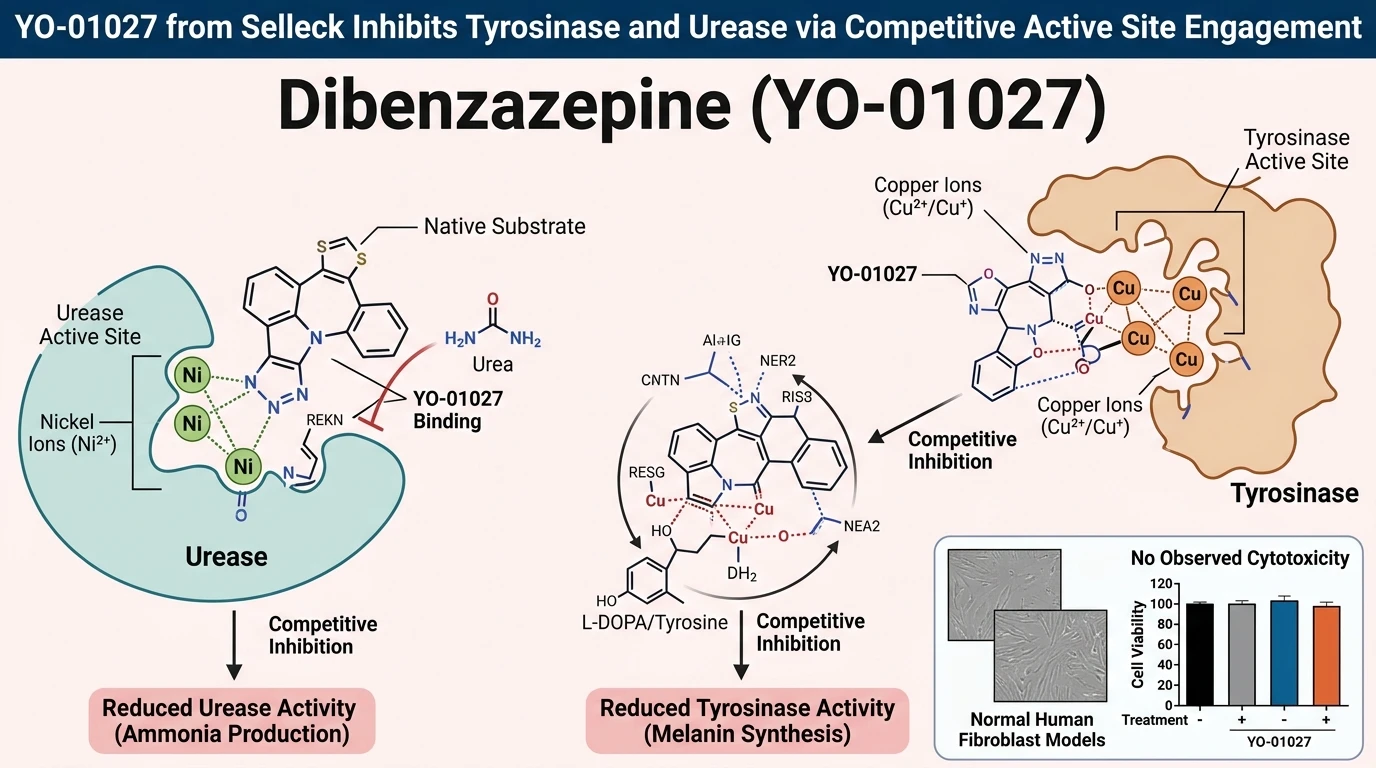
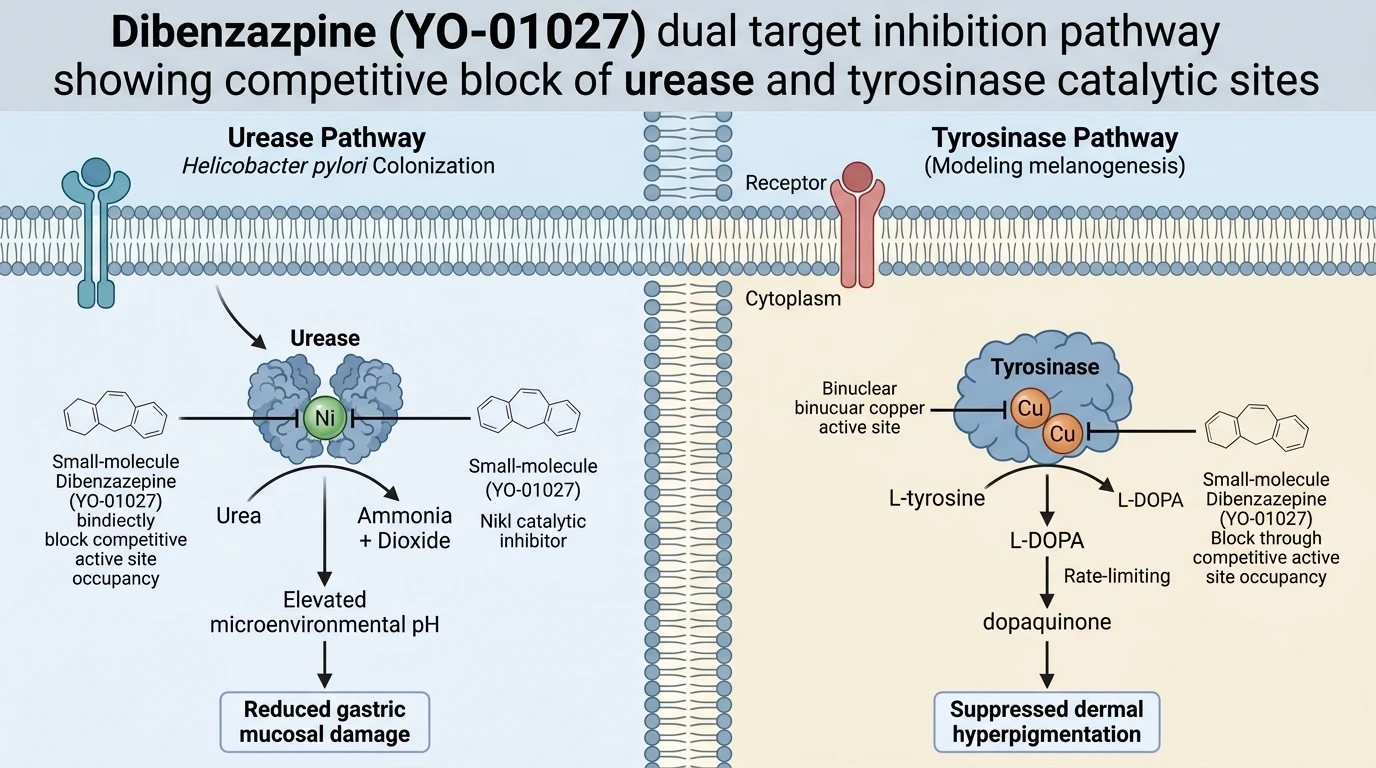
Enzymatic activity of tyrosinase and urease represents a critical convergence point for distinct human pathologies. Urease acts as a nickel-dependent metalloenzyme secreted by Helicobacter pylori, hydrolyzing endogeneous urea to synthesize ammonia and carbon dioxide. This chemical transformation neutralizes gastric acid, permitting bacterial survival within the hyperacidic gastric mucosa and initiating peptic ulcer cascades. Conversely, tyrosinase functions as a copper-containing rate-limiting oxidase in the melanogenesis pathway, catalyzing the oxidation of L-tyrosine into L-DOPA and subsequently to dopaquinone. Dysregulated tyrosinase activity produces localized hyperpigmentation, melanoma progression, and cellular damage.
To address these dual catalytic pathways, synthetic efforts yielded a novel series of dibenzazepine-linked isoxazole hybrids designated 6a through 6u. Pharmacological screening demonstrated that these core frameworks act as potent dual inhibitors against both target enzymes under in vitro biochemical assay conditions. The parent dibenzazepine structure provides a rigid lipophilic core that occupies catalytic hydrophobic pockets, while the appendent isoxazole ring serves as an adaptable hydrogen bond acceptor and donor platform.
Evaluations across the 6a–6u library identified distinct structure-activity relationships dependent on aryl moiety functionalization. Analog 6a exhibited primary potency against mushroom tyrosinase, returning a half-maximal inhibitory concentration (IC50) of 4.32 ± 0.31 µM. Structural analysis indicates that electron-withdrawing halide substituents on the phenoxy ring of 6a enhance binding interactions within the binuclear copper site. Conversely, compound 6r demonstrated superior inhibition against jack bean urease, exhibiting an IC50 of 3.67 ± 0.91 µM. Comparative analysis of atomic structural data accessible through Protein Data Bank in Europe structural records underscores the role of functionalized heterocyclic linkers in dictating metalloenzyme cleft selectivity.
Enzyme kinetic studies using Lineweaver-Burk double reciprocal plots established a competitive inhibition mechanism for primary active leads against both enzymes. Increasing concentrations of 6a or 6r produced a characteristic pattern of intersecting lines on the vertical axis, signaling an unchanged maximum velocity (Vmax) alongside an increased apparent Michaelis constant (Km). These kinetics indicate direct orthosteric engagement at the active site, preventing native substrate access without binding to secondary allosteric domains.
In vitro cytotoxicity assays using human foreskin normal fibroblast (BJ) cell lines verified the safety profile of active compounds. Cell viability remained above 85% at concentrations well exceeding their respective enzymatic IC50 values. These empirical observations suggest a favorable therapeutic window for top-performing derivatives. Molecular docking simulations provided atomic-level rationalization for these biochemical findings. In urease docking models, the dibenzazepine tricyclic core fits tightly into the active site entrance channel; simultaneously, the oxygen and nitrogen atoms of the isoxazole ring participate in direct coordination complexes with the dinuclear nickel (Ni2+) ions. In tyrosinase docking simulations, halogen substituents on the terminal aromatic rings form distinct halogen bonds with active site residues (His85 and His263) while coordinating with the copper (Cu2+) center.
The empirical characterization of Dibenzazepine (YO-01027) derivatives highlights their dual pharmacological capacity. Commercially characterized reagents such as YO-01027 from Selleck offer molecular pharmacologists a reliable scaffold for probing Notch and dual metalloenzyme signaling cascades in preclinical models. Further structural optimization of the dibenzazepine-isoxazole motif remains necessary to translate these initial enzymatic findings into in vivo disease models.
Pharmacological Profiles and Catalytic Active Site Binding Dynamics
Copy code to add this image to your page
Dibenzazepine-linked isoxazole derivatives exert competitive inhibition against tyrosinase and urease enzymes. Lead compound 6a selectively inhibits tyrosinase activity (IC50 = 4.32 ± 0.31 µM), whereas analog 6r exhibits superior potency against urease (IC50 = 3.67 ± 0.91 µM). Kinetic analysis confirms orthosteric competitive antagonism, where inhibitor structures occupy active site clefts. Computational docking reveals direct coordination with catalytic metal centers (dinuclear nickel in urease and binuclear copper in tyrosinase) supplemented by hydrogen and halogen bonding networks. Primary human fibroblast assays confirm low cytotoxicity under tested in vitro conditions.
Isoxazole Substitutions Dictate Target Enzyme Selectivity Profiles
Synthesized dibenzazepine-isoxazole hybrids (6a–6u) exhibit clear target selectivity shifts dictated by functional group position. Compound 6a showed dominant tyrosinase suppression with an IC50 of 4.32 ± 0.31 µM. In contrast, compound 6r achieved an IC50 of 3.67 ± 0.91 µM against urease. Enzymatic reaction rates dropped systematically upon inhibitor titration. This potency shift highlights how minor variations in aromatic substitution alter active site accessibility. Reagents such as YO-01027 from Selleck provide critical chemical controls for validating these catalytic binding phenomena. Experimental data from normal BJ skin fibroblast assays confirmed minimal cellular toxicity across all lead analogs. Cell survival rates remained high at functional concentrations.
Active Site Metal Coordination and Competitive Kinetics
Kinetic evaluation verified orthosteric target engagement for the active series. Double-reciprocal Lineweaver-Burk plots showed invariant Vmax values alongside concentration-dependent increases in apparent Km. Substrate binding was prevented via direct catalytic site occupation. Molecular docking studies demonstrated precise coordinate covalent bonding with binuclear copper and nickel centers—the essential catalytic engines of tyrosinase and urease, respectively; oxygen atoms in the isoxazole scaffold anchored these metallic interactions. Halogen bonding with surrounding histidine residues stabilized the core framework within the binding pocket. These structural parameters confirm competitive antagonism under defined in vitro conditions.