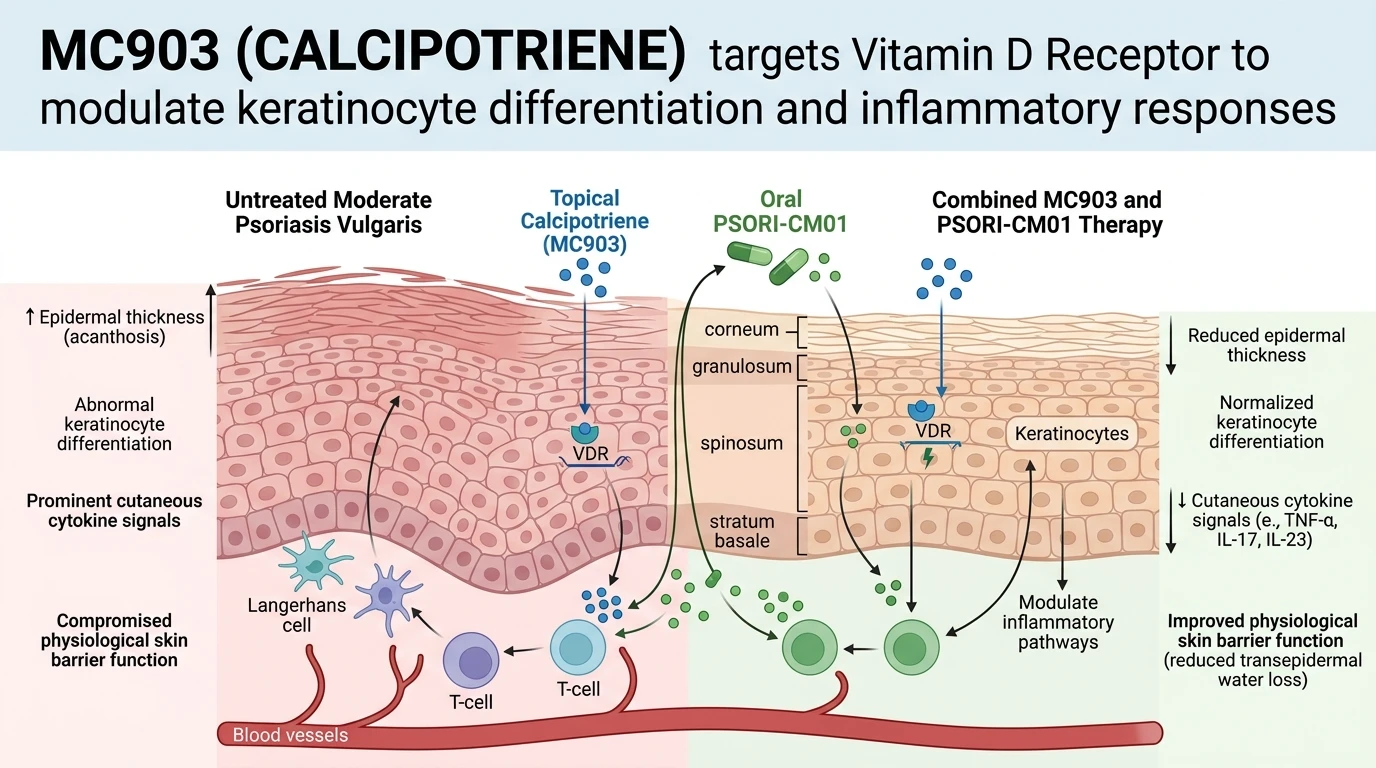
MC903 (Calcipotriene) targets Vitamin D Receptor to modulate keratinocyte differentiation and inflammatory responses
Copy code to add this image to your page
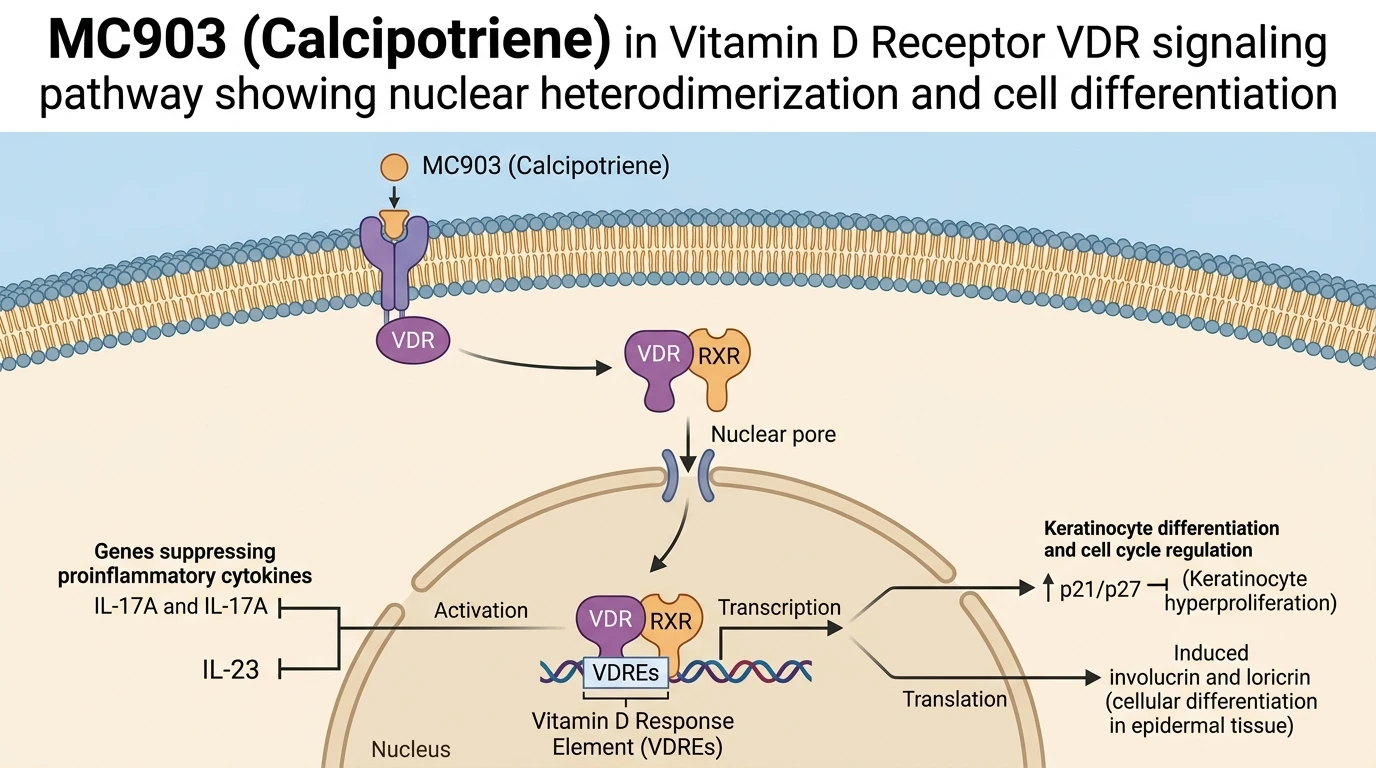
MC903 (Calcipotriene) functions as a synthetic vitamin D3 analog with nanomolar affinity for the nuclear Vitamin D Receptor (VDR). Calcipotriene displays target receptor affinity comparable to endogenous calcitriol, yet exhibits approximately 100-fold lower calcemic activity in vivo. Rapid hepatic metabolic clearance limits systemic hypercalcemic liability, making the compound well suited for localized dermatological applications. Upon intracellular entry, ligand engagement induces a precise conformational transition within the VDR ligand-binding domain. This structural shift facilitates non-covalent recruitment of the Retinoid X Receptor (RXR) alpha isoform, generating a stable heterodimeric transcription factor complex. The resulting VDR-RXR heterodimer translocates into the cell nucleus, binding directly to canonical hexameric repeat Vitamin D Response Elements (VDREs) embedded within target gene promoters. Through recruitment of coregulatory complexes—including steroid receptor coactivators and histone acetyltransferases—the complex modulates transcript biosynthesis for key regulatory proteins governing epidermal cell homeostasis.
In hyperproliferative psoriatic keratinocytes, target engagement by MC903 (Calcipotriene) initiates pronounced cell cycle arrest at the G1/S boundary. Heterodimer binding to VDREs upregulates gene transcription for cyclin-dependent kinase inhibitors, specifically p21 (CIP1/WAF1) and p27 (KIP1). Rising cellular concentrations of p21 and p27 directly bind and inhibit cyclin E-CDK2 and cyclin D-CDK4 catalytic complexes. Hyperphosphorylation of the retinoblastoma protein (Rb) is consequently blocked. Unphosphorylated Rb remains complexed with E2F transcription factors, arresting cellular replication. Downstream DNA synthesis drops sharply. Concurrently, VDR signaling drives terminal keratinocyte differentiation. Transcription of structural envelope markers—including transglutaminase-1, involucrin, filaggrin, and loricrin—is elevated under experimental conditions. This shifts immature, rapidly dividing keratinocytes toward terminal cornified envelope formation.
In parallel to cell cycle control, VDR target activation exerts potent immunomodulatory control over the cutaneous inflammatory microenvironment. Binding of MC903 (Calcipotriene) to VDR inhibits transcription of proinflammatory cytokines through direct interference with nuclear factor kappa B (NF-κB) subunits and nuclear factor of activated T-cells (NFAT). In dermal dendritic cells and Langerhans cells, VDR stimulation downregulates key costimulatory molecules (CD80, CD86) and interleukin-12/23 p40 expression. Reduced IL-23 output blunts the survival and expansion of T-helper 17 (Th17) lymphocytes within active skin lesions. Production of downstream effector cytokines, including IL-17A, IL-17F, and IL-22, decreases markedly. Lower cytokine concentrations reduce the expression of chemoattractants (CXCL1, CXCL8) in surrounding parenchymal cells. Neutrophil recruitment into the epidermis ceases.
Despite established topical single-agent efficacy, clinical management of moderate psoriasis vulgaris frequently requires multimodal strategies to enhance patient outcomes. To evaluate systemic-topical interactions, a pilot randomized, double-blind, placebo-controlled clinical trial evaluated the combination of oral traditional Chinese medicine formulation PSORI-CM01 with topical calcipotriol. The study enrolled patients diagnosed with moderate psoriasis vulgaris, randomizing them to receive either topical calcipotriol monotherapy or calcipotriol combined with adjunctive oral PSORI-CM01. Clinical assessment relied on objective Psoriasis Area and Severity Index (PASI) measurements, alongside patient-reported outcome measures including the Dermatology Life Quality Index (DLQI) and the Skindex-29 scale.
Primary outcome analysis revealed substantial PASI score improvements across both intervention groups over the course of treatment. Statistically significant differences between the combination regimen and calcipotriol monotherapy were not observed in the primary PASI response rates within this specific study cohort. However, secondary outcome evaluations demonstrated distinct, statistically significant benefits in patient quality-of-life parameters. Patients receiving adjunctive PSORI-CM01 exhibited superior reductions in DLQI and Skindex-29 symptom subscores. Safety assessments confirmed that combination therapy was well tolerated, exhibiting no severe treatment-emergent adverse events or laboratory abnormalities. These preliminary findings validate the safety profile and therapeutic potential of combining systemic botanical formulations with topical VDR agonists in clinical trial settings.
Clinical Efficacy and Symptom Metrics in Psoriasis Vulgaris
Copy code to add this image to your page
MC903 (Calcipotriene) acts as a high-affinity Vitamin D Receptor agonist. Binding initiates VDR heterodimerization with Retinoid X Receptor, binding nuclear response elements to halt epidermal cell cycle progression at G1 phase through p21/p27 elevation. Simultaneously, VDR signaling downregulates nuclear factor kappa B (NF-κB) transcription, decreasing proinflammatory IL-17A, IL-22, and TNF-α secretion. This suppresses keratinocyte hyperproliferation, dampens cutaneous dendritic cell activation, and restores structural differentiation pathways in psoriatic lesions.
PASI Score Dynamics Under Topical Calcipotriene Monotherapy versus Combination
In the clinical evaluation of moderate psoriasis vulgaris, objective reduction in lesion area and severity serves as the primary benchmark of pharmacodynamic activity. Both treatment groups receiving topical MC903 (Calcipotriene) displayed marked reductions in baseline PASI values. Keratinocyte hyperproliferation was suppressed. Mean plaque thickness decreased significantly over the twelve-week evaluation period. However, primary clinical outcome comparisons revealed no statistically significant difference in PASI score reductions between the combination therapy group and the monotherapy control cohort under these specific clinical trial parameters. Objective clinical clearance rates remained comparable across both arms. This observation indicates that short-term topical VDR target saturation may define the upper limit of macro-lesion clearance regardless of adjunctive oral intervention.
Quality-of-Life Benefit via Add-On PSORI-CM01 Administration
Although primary PASI metrics showed comparable objective skin clearing, patient-reported outcomes highlighted meaningful functional divergence between treatment arms. Patients receiving oral PSORI-CM01 alongside topical therapy exhibited statistically significant improvements across DLQI and Skindex-29 instruments. Cutaneous pruritus intensity dropped rapidly within weeks of therapy initiation. Subscale analyses revealed marked reductions in patient-reported emotional distress, functional impairment, and localized burning sensations. These findings suggest that systemic modulation of peripheral cytokine profiles may alleviate neurosensory and quality-of-life burdens before complete anatomical lesion resolution is captured by standard PASI grading. The dual regimen proved safe, with zero severe adverse events recorded during the trial protocol.